 |
|
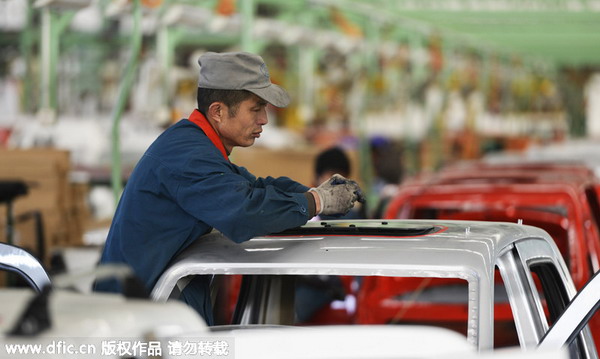
A Chinese worker assembles a new energy car on the assembly line at an auto plant in Zouping county, East China's Shandong province, Dec 16, 2014. [Photo / IC] |
Even before China became the world's No 1 manufacturing base in 2010, the "made-in-China" label was everywhere.
Books, such as A Year Without "Made in China": One Family's True Life Adventure in the Global Economy by American journalist Sara Bongiorni, testified to the omnipresence of China-made goods.
Yet that same book also noted the embarrassing fact that the made-in-China label was by and large a down-market signifier.
For quite some time, "made in China" has been synonymous with cheap and inferior quality goods. As one Chinese trade official said years ago, foreign trade had long been sewing shirts for overseas markets in exchange for airplanes.
Thanks to abundant supplies of cheap labor, China became the "factory of the world". This enabled it to lift hundreds of millions of people out of poverty.
But as the demographic defects of our population structure present themselves, as the environmental cost of wasteful and polluting ways of production become increasingly obvious and as some transnational corporations turn their eyes to less developed neighboring countries for their manufacturing needs, it is time to rethink our approach to "made in China".
"Made in China 2025", which the State Council, China's cabinet, released on Wednesday, is an ambitious road map to what Premier Li Keqiang has touted as an "upgraded version of made in China". At its core is a "three-step" plan aimed at turning the country into a world leader in manufacturing in a little more than three decades. That is a very long way to go.
In 2014, a total of 100 mainland Chinese firms made it onto the Fortune Global 500 list, among which 56 were in manufacturing.
That sounded impressive. The number was second only to the United States, after all.
But like in many similar rankings, Chinese firms stood out because of their size, not their strength.
Four Chinese companies appeared on the top-10 roster of the planet's most profitable ones last year. Yet none was in manufacturing.
Big, but not strong: There is no better way to describe Chinese manufacturing.
With the country approaching the Lewis Turning Point, a point at which surplus rural labor disappears and a labor shortage emerges, our comparative advantage in low labor cost is evaporating. The traditional low-tech, labor-intensive processing is hardly sustainable.
A healthy national economy cannot go without robust manufacturing. But "innovation-driven" manufacturing entails a lot more than political will.
Without a systematic environment that encourages innovation, respects intellectual property rights, and rewards risk, three decades will prove too short for such a grand objective.
Unfortunately, the current road map has not placed sufficient weight on these crucial aspects.
 Being unaware of hypocrisy is itself hypocrisy

Copyright 1995 - . All rights reserved. The content (including but not limited to text, photo, multimedia information, etc) published in this site belongs to China Daily Information Co (CDIC). Without written authorization from CDIC, such content shall not be republished or used in any form. Note: Browsers with 1024*768 or higher resolution are suggested for this site.
License for publishing multimedia online 0108263 Registration Number: 130349