 |
|
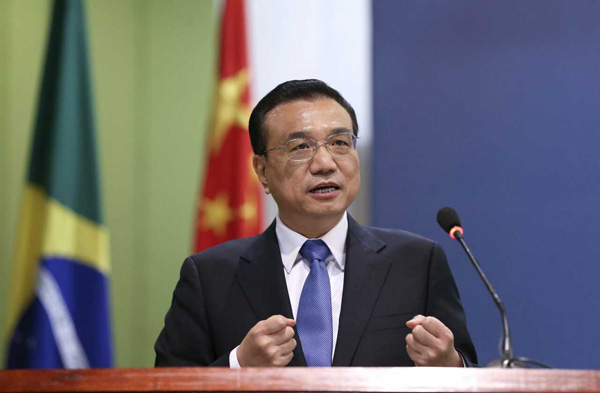
Premier Li Keqiang addresses the closing ceremony of a bilateral business summit in Brasilia, Brazil on May 19, 2015. [Photo/Xinhua] |
Premier Li Keqiang's ongoing visit to four Latin American countries reflects China's long-term commitment to the region, which should not be judged on the basis of the zero-sum game of rivalry, because it is based on win-win cooperation, equality and mutual respect.
Latin America, seen as the "backyard" of the United States since the 1823 declaration of the Monroe Doctrine, has undergone profound changes in recent years. Today, any mention of Latin America as "the US' backyard" will offend many in the region. That explains why US Secretary of State John Kerry had to say in November 2013 that the era of the Monroe Doctrine was over. His statement came about six months after he sparked protests in Latin America by using the term for the region.
Yet such terms have been let loose every time China has tried to boost its ties with Latin American countries in recent years. Some have alleged that China's closer engagement with the region is aimed at projecting its power in a region that the US believes to be under its influence.
Some observers have even alleged that China is only interested in the natural resources in the region. And similar criticisms are heard every time China and African countries try to deepen their cooperation.
In fact, quite a few analysts have said the US' reconciliation with Cuba is part of its policy to counterbalance China's increasing influence in the region. But this is an oversimplified interpretation of international relations and underestimates Latin American countries' growing desire to interact with the outside world.
Gone are the days when Latin American countries were overwhelmed by the so-called US sphere of influence. With left-wing political parties becoming popular in Latin America, countries in the region exhibiting growing solidarity and greater determination for regional integration have emerged as important players on the world stage.
It is in this backdrop that China-Latin America ties have been marching forward. China's presence in the region is aimed at forging win-win cooperation and achieving common development, and China has no intention of offsetting the US' influence in the region.
Though tens of thousands of miles apart, China and Latin America are complementary to each other in terms of economy; they share similar views on a wide range of global and regional issues too.
The four countries on Li's itinerary - Brazil, Colombia, Peru and Chile - together account for about 57 percent of the China-Latin America trade. Apart from signing deals in areas such as mining, energy and agriculture, the two sides are expected to explore the potential of cooperation in infrastructure and technology during Li's visit.
Two-way trade between China and Latin America last year reached $263.6 billion, a 20-fold increase from 2000. And statistics from the Ministry of Commerce show China's investment in the region reached more than $80 billion last year.
China and Latin America have set a goal to increase their trade to $500 billion a year within a decade. Indeed, China's deep pocket and technological know-how and Latin America's abundant natural resources will ensure a brighter future for their cooperation.
Closer cooperation between China and Latin America in areas such as infrastructure, energy, finance and agriculture will create more business opportunities for enterprises and companies from across the world, including those from the US.
Therefore, viewing China's interactions with Latin American countries with a zero-sum mentality will not only mislead public opinion, but also run counter to the trend of the times of increasing intertwining of the two sides' interests.
Latin American countries' deeper economic ties with both China and the US, two of the world's largest economies, can result in win-win outcomes. But for that to happen, the US has to start viewing China as a competitive partner, not a rival.


Copyright 1995 - . All rights reserved. The content (including but not limited to text, photo, multimedia information, etc) published in this site belongs to China Daily Information Co (CDIC). Without written authorization from CDIC, such content shall not be republished or used in any form. Note: Browsers with 1024*768 or higher resolution are suggested for this site.
License for publishing multimedia online 0108263 Registration Number: 130349