 |
|
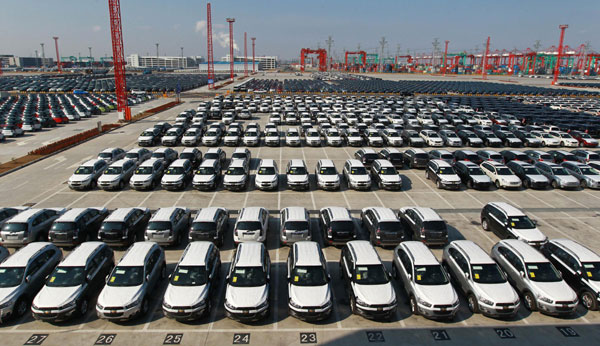
The automobile roll-on/roll-off wharf at the Waigaoqiao bonded zone in Shanghai, Jan 17, 2013. [Photo/Xinhua] |
After sustaining its fast development for decades, China has started a new chapter in its opening-up process. But the way ahead is more challenging than the inward opening up that was initiated more than 30 years ago.
China's unfolding opening-up drama started with a small fishing village in South China close to Hong Kong. The village boomed under the opening-up policy, and soon Shenzhen was known around the world.
Shenzhen, Zhuhai, Shantou and Xiamen were China's first four special economic zones, and their success prompted Deng Xiaoping, the architect of the opening-up and reform policy, to establish 14 "open" cities along China's coastline.
In 1992, Deng urged further deepening of the country's opening up by setting up the Pudong Special Economic Zone in Shanghai. And at the turn of the century, China sought to balance regional development by launching the Western Development Strategy to open up the central and western regions.
In 2001, China became a World Trade Organization member, which was a milestone in the country's process of saying goodbye to the planned economy.
With China's companies engaging with international markets, the government began encouraging them to invest globally, and amid the 2008-09 financial crisis and European debt turmoil, this trend accelerated.
However, the fast growth of China's economy after the launch of reform and opening-up has been accompanied by rampant corruption, severe pollution, a widening gap between the coastal and inland regions and growing inequality. Since Xi Jinping took office as the top leader of the Party and country, he has been determined to address these problems by making major policy changes.
Xi is a down-to-earth doer, and he was quick to instigate changes and make proposals, introducing a tough anti-corruption campaign and the establishment of the Silk Road Economic Belt and the 21st Century Maritime Silk Road to give a fresh boost to the economy.
Early this year, the central government made public its vision of the Belt and Road Initiatives and urged the provinces, municipalities and autonomous regions to link their development plans to them. China has also set up the Asian Infrastructure Investment Bank and Silk Road Fund to help finance projects under the framework of the proposal.
This year, Xi has already visited Pakistan, Indonesia, Kazakhstan, Russia and Belarus, where the discussions have focused on pushing forward the Belt and Road Initiatives with cooperation in a variety of areas.
Xi has even engaged Russia to discuss feasibility of free trade agreement with some countries along the Silk Road Economic Belt.
China is sincere in seeking to deliver win-win results from its new opening up policy. Before 2012, China mainly focused on opening up inwardly by upgrading its capabilities and capacities in manufacturing. In that process, developed economies have benefited from China's growth by investing in China.
China is now starting to invest on large scale in other economies, especially those short of capital and technologies, helping them to develop their infrastructure and manufacturing, and encouraging trade.
Of course, the modern Silk Roads will extend well beyond the ancient routes, and they could, if economies are willing, encompass the world.
This outward opening up will be a steep learning curve for China. The context in which it is taking place has changed dramatically compared to the early days of the internal opening-up policy focused on attracting investment.
China needs to keep this in mind and strive for efficient communication.
Now, disseminating the content of the Silk Road vision paper is key. In doing so, China can develop more mutually beneficial projects with other countries, which will begin to lay the foundations for the modern Silk Roads.
The author is China Daily chief correspondent in Brussels. fujing@chinadaily.com.cn



I’ve lived in China for quite a considerable time including my graduate school years, travelled and worked in a few cities and still choose my destination taking into consideration the density of smog or PM2.5 particulate matter in the region.
Copyright 1995 - . All rights reserved. The content (including but not limited to text, photo, multimedia information, etc) published in this site belongs to China Daily Information Co (CDIC). Without written authorization from CDIC, such content shall not be republished or used in any form. Note: Browsers with 1024*768 or higher resolution are suggested for this site.
License for publishing multimedia online 0108263 Registration Number: 130349