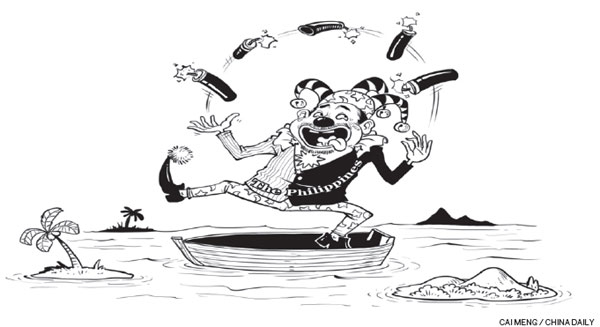
The Philippines has intensified its diplomatic and military game over its territorial dispute with China in the South China Sea.
Accompanied by a group of journalists including foreign correspondents based in the Philippines, Gregorio Pio Catapang Jr, the country's military chief, paid a high-profile visit on Monday to China's Zhongye Island, which has been illegally occupied by Manila since the 1970s. China has condemned the pointless farce and urged the Philippines to stop its provocations regarding disputed areas in the South China Sea.
Although the Philippines is one of the first countries to lay claim to the Nansha Islands and carry out extensive construction work for expanding insular features on illegally occupied islands (for example, Zhongye Island), it has condemned China for doing the same, saying such activities will "cause damage to the ecological environment of the South China Sea".
Even when a Philippine military plane infringed upon China's sovereignty by illegally entering the air space above China's Shubi Reef, Manila criticized Beijing by accusing Chinese military vessels of using strong lights against the plane.
Why is Manila labeling such accusations against Beijing? The accusations fit into the narrative of portraying China as an "assertive" and even "aggressive" major power. The Philippines' aim is to gain the support of countries that see China as an existing or potential challenge to their interests (for example, the United States), or which also have disputes with China (for instance, Japan).
Manila's strategy plays out well with the international media controlled by Western corporations. The dominating narrative presents China as an "assertive" and/or "aggressive" country that not only bullies its weaker neighbors like the Philippines, but also acts in contravention of international law. This serves the Philippines' purpose of garnering more support of the "international community" against China. It also serves the purpose of damaging China's international image.
An important role of the strategy is to serve the case that the Philippines unilaterally initiated against China in the arbitral tribunal based in The Hague, the Netherlands, in January 2013. The arbitral tribunal will conduct a hearing in July 2015 to "address the objections" to its jurisdiction as stated in China's position paper on the case.
By approaching the International Tribunal for the Law of the Sea with the case, Manila has forfeited the chance of resolving the issue through bilateral efforts. The unilateral move by the Philippines runs counter to both bilateral and regional attempts to resolve the South China Sea issue. And the Benigno Aquino III government will lose its credibility if it loses the case in the arbitral tribunal.
To avoid such a situation, therefore, Manila has to make every effort, including painting Beijing in bad light, which fits its anti-China global campaign. The repercussions of the case on bilateral ties have become obvious and could worsen as the arbitration proceeds.
All incidents related to the China-Philippines dispute - even the arbitration case wrapped in legal terminology - have been dangerously politicized. The full ramification has yet to play out, but the repercussions on bilateral relations could affect the regional order, too.
Facing new challenges in the South China Sea issue, China adopted a "dual-track approach" in August. According to this approach, specific disputes were to be resolved through negotiations and consultations by countries directly involved on the basis of international law and historical facts, while peace and stability in the region were to be jointly maintained by China and ASEAN member states.
But Manila has chosen to ignore the fact that joint efforts at the bilateral as well as regional levels can create an environment conducive to peace. The Philippines recurrently goes against the international law and the Declaration on the Conduct of Parties in the South China Sea and keeps taking provocative actions which undermine mutual trust among all parties and regional stability. What happens lays bare that the Philippines is the real rule-breaker and trouble-maker.
The author is research fellow with the National Institute for South China Sea Studies.



I’ve lived in China for quite a considerable time including my graduate school years, travelled and worked in a few cities and still choose my destination taking into consideration the density of smog or PM2.5 particulate matter in the region.
Copyright 1995 - . All rights reserved. The content (including but not limited to text, photo, multimedia information, etc) published in this site belongs to China Daily Information Co (CDIC). Without written authorization from CDIC, such content shall not be republished or used in any form. Note: Browsers with 1024*768 or higher resolution are suggested for this site.
License for publishing multimedia online 0108263 Registration Number: 130349