 |
|
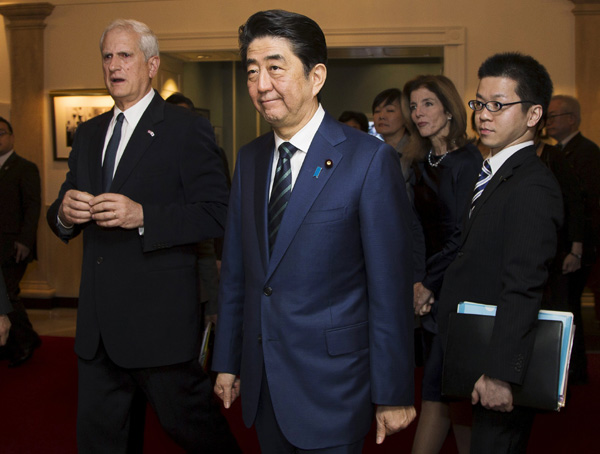
Japanese Prime Minister Shinzo Abe (C) tours the John F. Kennedy Presidential Library with US Ambassador to Japan Caroline Kennedy Schlossberg (2nd R) and her husband Edwin Schlossberg (L) in Boston, Massachusetts April 26, 2015. [Photo/Agencies] |
On Wednesday, Japanese Prime Minister Shinzo Abe addresses the joint houses of the US Congress in Washington. That day is also the official birthday of the late Japanese Emperor Hirohito; were he alive (he died in 1989) he would be celebrating his 114th birthday. It is worth reflecting on the implications of the coincidence of these two events.
In the late 19th and early 20th century, Japan was the only non-Western nation to become an industrial and imperialist power. This occurred under the reign of Hirohito's grandfather, Emperor Mutsuhito, who chose Meiji, which translates as "enlightened rule", as the name to symbolise his reign.
In 1926 when Hirohito ascended the throne, Japan had already joined the ranks of the "great powers", through victories in successive wars against China (1894-95) and Russia (1904/05), and alliance with Great Britain (1902), as well as joining the allies in World War I (1914-18) and sitting at the Paris Peace Treaty, he chose Sh?wa, which translates as "peaceful harmony" for the name of his reign.
In the 20th year of his rule, 1946, looking back on the carnage Japan had wrought over China and all of East Asia through war and plunder in the preceding decade-and-a-half; it would have been difficult to imagine that Hirohito would die peacefully in his sleep more than?40 years later, outliving all the other major figures of World War II. Yet this phenomenon illustrates the crucial difference in the post-war settlement in Europe and in Asia.
In Europe, two things were accomplished, namely integration through institution and confidence building, generated by the unconditional repentance of Germany and its reconciliation with its former enemies. Today Europe, current economic and socio-political problems notwithstanding, is at peace.
World War II is a closed chapter of history. At the celebrations to mark the 70th anniversary of the D-Day Normandy landings in June 2014, not only were the heads of governments of the allied powers present, so too was German Chancellor Angela Merkel, and surviving veterans from both sides embraced.
In Asia the scenario could hardly be more different. While the United States, Great Britain and Russia had been allied with China in the fight against the Japanese, the Cold War and the profound political transformations in China leading to Liberation in October 1949 dramatically altered the script.
Washington sought to ostracize the Chinese government based in Beijing, by "recognising" the government of Chiang Kai-shek in Taipei, and by rapidly rehabilitating Japan. It became more important for Washington to strengthen Japan than to punish Japan. In 1951 Washington signed a security treaty with Tokyo that remains in force.
The decision was taken not to prosecute Emperor Hirohito, and many war criminals who had been imprisoned were summarily freed (including Shinzo Abe's grandfather Nobusuke Kishi, who became prime minister from 1957 to 1960), on the grounds that their administrative skills were needed to rebuild Japan.
One can contrast the situations in Europe and East Asia by saying that while in Germany there was full rehabilitation based on a thorough cleansing of the war-time establishment - no former Nazi has held a prominent political position in Germany - in Japan there was rehabilitation without the cleansing.
Thus whereas there can be absolutely no doubt that the Japan of today - a democratic, urbanised, educated, middle-class, essentially peace-loving society - is radically different from the Japan of the 1930s and 40s, the ghosts of the past still linger. For Tokyo, to unreservedly accept guilt for the atrocities committed, would mean admitting the guilt of Emperor Hirohito and, among many others, Abe's grandfather.
Former Governor of Tokyo Shintaro Ishihara, a member of the mainstream Liberal Democratic Party of Japan, has publicly denied the Nanjing massacre. Were a prominent German politician, such as the Mayor of Berlin, to deny a Nazi atrocity, say the destruction of the Warsaw Ghetto, not only would he be forced to resign, his political career would be finished, and there would be major popular protests of ordinary German citizens in the streets. Although many Japanese disapprove of Ishihara's odious remarks, he was not forced to resign and there were no demonstrations in the streets.
Until and unless the ghosts of Japan's wartime past are laid to rest, as has been the case with German Nazi ghosts, thus enabling Europe to live in peace now for several decades, the Asia-Pacific region will not be at peace.
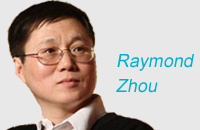
The author is emeritus professor at IMD in Lausanne, Switzerland and a visiting professor at University of Hong Kong.



I’ve lived in China for quite a considerable time including my graduate school years, travelled and worked in a few cities and still choose my destination taking into consideration the density of smog or PM2.5 particulate matter in the region.
Copyright 1995 - . All rights reserved. The content (including but not limited to text, photo, multimedia information, etc) published in this site belongs to China Daily Information Co (CDIC). Without written authorization from CDIC, such content shall not be republished or used in any form. Note: Browsers with 1024*768 or higher resolution are suggested for this site.
License for publishing multimedia online 0108263 Registration Number: 130349