|
 |
|
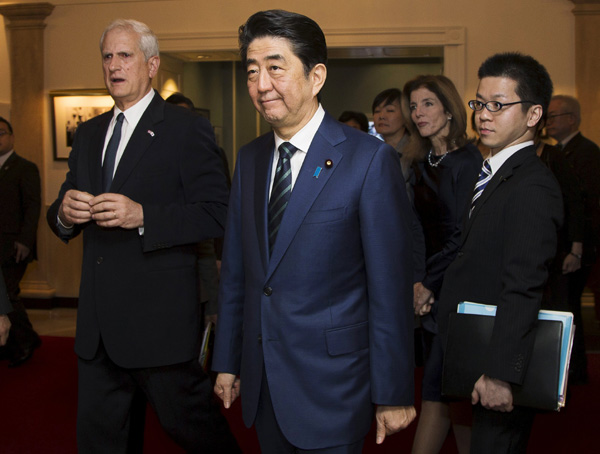
Japanese Prime Minister Shinzo Abe (C) tours the John F. Kennedy Presidential Library with US Ambassador to Japan Caroline Kennedy Schlossberg (2nd R) and her husband Edwin Schlossberg (L) in Boston, Massachusetts April 26, 2015. [Photo/Agencies] |
President Xi Jinping and Japanese Prime Minister Shinzo Abe held a meeting, their second since November, on April 22 on the sidelines of the 2015 Asian-African Summit in Jakarta, where Abe vowed to uphold Japan’s past apologies for the atrocities his country committed before and during World War II and hoped “very much to improve Japan-China relations”.
Yet in his address to the summit earlier on that day, Abe expressed deep remorse over the war led by Japan without mentioning whether he would abide by the statements of his predecessors or offer sincere apologies to the Asian countries that suffered under Japan’s “colonial rule and aggression” before and during WWII.
With many countries set to commemorate the 70th anniversary of the end of WWII on Aug 15, Abe as the leader of a former fascist power will attract close attention when he addresses the US Congress on April 29 and issues a statement in Japan on Aug 15.
On April 20, six days before he began his weeklong visit to the US, The New York Times said Abe had failed to settle Japan’s wartime history. “The success of the (US) visit also depends on whether and how honestly Mr Abe confronts Japan’s wartime history”, the newspaper’s editorial said.
Indeed, a few Japanese right-wing politicians have been trying since the 1980s to restore Japan’s “dignity” by revising, even denying, the country’s military past. But the result of their sordid efforts has been the opposite: Japan has been losing its credibility as a peace-loving country that prioritizes economic recovery over everything else. And the Abe administration’s aggressive military strategy has made that loss of credibility more profound.
Notably, Abe is a semi-nationalist rather than a pro-US Japanese leader. Unlike his predecessor Yukio Hatoyama, who said Tokyo and Washington should treat each other as equals, Abe wants to use the US-Japan alliance to maximize Japan’s interests. His ambiguous attitude and vague remarks on Japan’s wartime atrocities before visiting the US suggest that he intends to neither own to Japan’s wartime past nor apologize to Washington for attacking Pearl Harbor in 1941. Instead, he expects an apology from the US for the devastating atomic bombings of Hiroshima and Nagasaki that killed 129,000 people.



I’ve lived in China for quite a considerable time including my graduate school years, travelled and worked in a few cities and still choose my destination taking into consideration the density of smog or PM2.5 particulate matter in the region.
Copyright 1995 - . All rights reserved. The content (including but not limited to text, photo, multimedia information, etc) published in this site belongs to China Daily Information Co (CDIC). Without written authorization from CDIC, such content shall not be republished or used in any form. Note: Browsers with 1024*768 or higher resolution are suggested for this site.
License for publishing multimedia online 0108263 Registration Number: 130349