 |
|
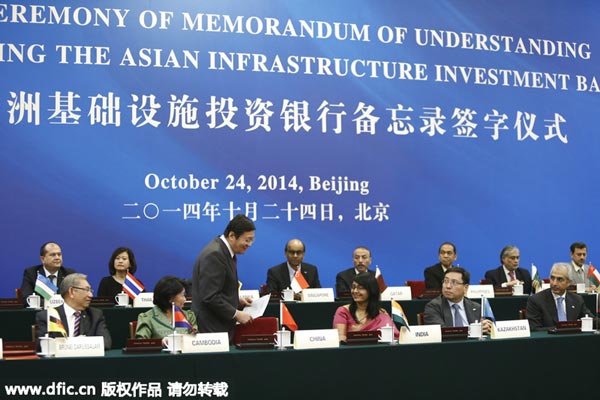
China's Minister of Finance Lou Jiwei, front third left, and other representatives of founding member countries attend the signing ceremony of memorandum of understanding on establishing the Asian Infrastructure Investment Bank (AIIB) in Beijing, Oct 24 2014. [Photo/IC] |
China should stop other countries from politicizing the Asian Infrastructure Investment Bank and the "Belt and Road Initiative" by making the projects' strategic objectives clear to the world and ensuring they function transparently and efficiently. This is vital because through these "go-global" initiatives, China can help make international rules fairer.
Handling international relations responsibly does not mean only helping a country with funds; it also means providing more public products to meet people's needs and cultivating developing countries' agenda-setting abilities in international politics.
Through the AIIB and "Belt and Road Initiative" frameworks, China needs to guide the international community's discussions and limited resources in a direction that would boost developing country's growth and restructuring, and benefit their people.
The Association of Southeast Asian Nations summit in 2010 issued an overall regional inter-connectivity plan, estimating that the more than 700 projects would need $380 billion in investments. The problem is that, when it comes to providing funds, some countries and international organizations always find excuses not to do so.
The existing regional and global financial institutions such as the Asian Development Bank, the World Bank and the International Monetary Fund are dominated by the United States and its Western allies, and impose harsh requirements on the countries seeking funds. Some of their conditions are ideologically prejudiced, and sometimes they even interfere with the internal affairs and sovereignty of applicant countries.
Although China is the largest fund provider for the AIIB and the "Belt and Road Initiative", these projects have been and will be carried out in agreement with other countries. Moreover, China does not seek veto power in the projects and it will certainly not follow the examples set by the ADB, World Bank and the IMF.
Many Western critics compare the "Belt and Road Initiative" and the AIIB to the Marshall Plan and the Bretton Woods system dominated by the United States after World War II. But being aimed at fostering common development, the China-led projects are fundamentally different from the latter two, which helped consolidate and defend US hegemony.
If the China-led projects are well implemented, they will also provide the developed economies with more accessible markets, expand aggregate global demand and power the world economy's total recovery.



I’ve lived in China for quite a considerable time including my graduate school years, travelled and worked in a few cities and still choose my destination taking into consideration the density of smog or PM2.5 particulate matter in the region.
Copyright 1995 - . All rights reserved. The content (including but not limited to text, photo, multimedia information, etc) published in this site belongs to China Daily Information Co (CDIC). Without written authorization from CDIC, such content shall not be republished or used in any form. Note: Browsers with 1024*768 or higher resolution are suggested for this site.
License for publishing multimedia online 0108263 Registration Number: 130349