 |
|
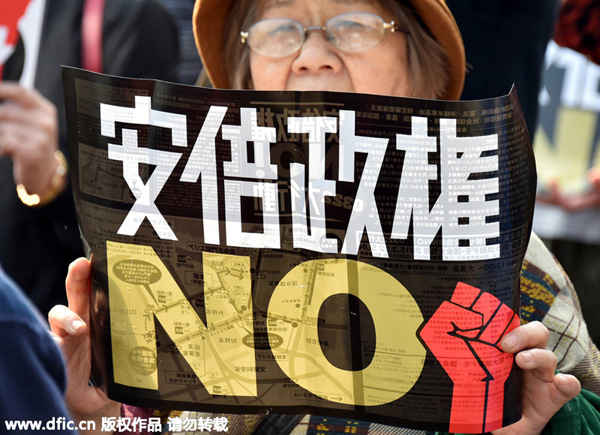
A demonstrator holds a sign, reading No to the Abe Administration, during a mass protest in the heart of Tokyo, March 22, 2015. [Photo/IC] |
How ridiculous Japanese Prime Minister Shinzo Abe is when he tries to portray himself as peace-loving on one hand and keeps straining ties between Japan and its neighboring countries on the other.
Just one day before he makes speech at the Asian-African Summit, Abe on Tuesday sent a ritual offering to the notorious Yasukuni Shrine where Japanese military dead since Meiji Restoration are enshrined, including the 14 A-class war criminals during World War II.
And in his five-minute presentation in Indonesia, Abe is likely to highlight that Japan, as a peace-loving country, has contributed much to global peace and development in the post-WW II era. He is also likely to focus on the "future"instead of "apologizing"for Japan's war crimes while speaking at the US Congress next week.
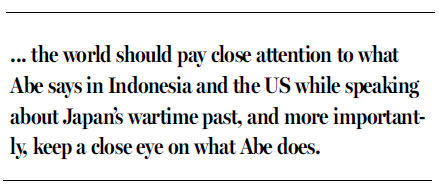
The two speeches may tell the world how Abe views Japan's notorious past and whether he wants genuine peace in the Asia-Pacific region and beyond. However, no matter what he says, Abe's bold move on Yasukuni Shrine has showed he never truly apologized for the Asian people's sufferings brought by Japanese army during the war past.
Since the Meiji Restoration began in 1868 to restore practical imperial rule, Japan annexed Ryukyu (now Okinawa) Islands, colonized the Korean Peninsula, invaded China and many Southeast Asian countries and waged the Pacific War before being defeated by the anti-fascist Allied forces in 1945.
After the end of World War II, the Japanese Constitution, drafted with the help of the US, stripped the Japanese emperor of his political and military powers and barred Japan from declaring war on any country. The arrangement seemed to suit Japan and its victim countries both. And the Yoshida Doctrine, named after Japan's first postwar prime minister Shigeru Yoshida, which emphasized Japan's economic recovery and reliance on US military protection at the expense of independence in foreign affairs, shaped Japanese foreign policy during the Cold War and beyond.
The policy helped the Japanese economy not only to recover but also to become the world's second-largest economy in the 1960s. By shifting focus from military build-up to economic development, Japan regained the trust of its once-victim neighbors such as China. This, in turn, helped establish China-Japan diplomatic ties in the 1970s.
But after being re-accepted by the international community as a leading economy, Japan started developing strategic ideas, that is, defying the postwar world order to become a military power again. In 1983, Yasuhiro Nakasone, then Japanese prime minister, made the pursuit of "political power"a national strategy. In the 1990s, Japanese politicians agreed on the "political power"strategy and many even advocated a slogan that Japan should develop politically and militarily as a "normal country”.



I’ve lived in China for quite a considerable time including my graduate school years, travelled and worked in a few cities and still choose my destination taking into consideration the density of smog or PM2.5 particulate matter in the region.
Copyright 1995 - . All rights reserved. The content (including but not limited to text, photo, multimedia information, etc) published in this site belongs to China Daily Information Co (CDIC). Without written authorization from CDIC, such content shall not be republished or used in any form. Note: Browsers with 1024*768 or higher resolution are suggested for this site.
License for publishing multimedia online 0108263 Registration Number: 130349