 |
|
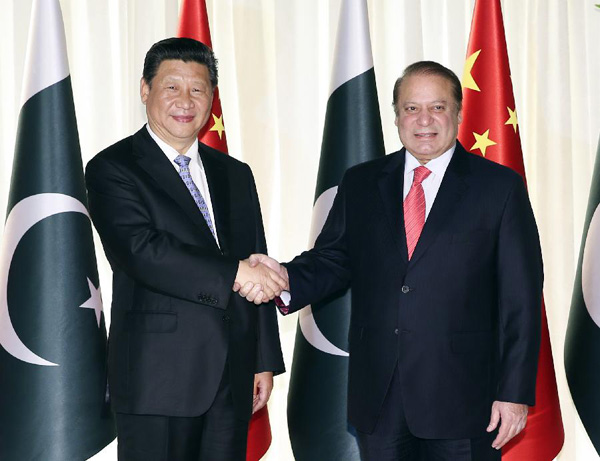
Visiting Chinese President Xi Jinping (L) holds talks with Pakistani Prime Minister Nawaz Sharif in Islamabad, capital of Pakistan, April 20, 2015. [Photo/Xinhua] |
Because of the sheer scope of China's financial commitment to meeting Pakistan's infrastructure and energy needs, as well as that country's peculiar geopolitical position in South Asia, President Xi Jinping's visit to Islamabad is being read by outsiders as a power play.
But that is a thorough misunderstanding of the Sino-Pakistani relationship.
For outsiders, the obvious disparity between the two immediate neighbors, in size, national strength and plenty of other aspects sets the stage for an unequal relationship.
But from Xi to the average man on the street in China, Pakistan has never been just another neighbor. Bilateral ties are approached here with a special sense of brotherhood. Few of China's partnerships with foreign countries have seen the degree of popular endorsement as that with Pakistan.
That Pakistan donated all the tents in its strategic reserves, more than 20,000, to China when an earthquake devastated Wenchuan in 2008 stands as an eye-watering footnote to the popular appellation batie, or "Pakistan our best buddy". Which was used by Xi during his talk about the two countries' "all-weather strategic partnership" with visiting Pakistani Prime Minister Nawaz Sharif in 2013. In 2014, Xi told visiting Pakistani President Mamnoon Hussain that our countries are good friends, partners, neighbors, and brothers that stand together through storm and stress. That explains why Xi's trip to Islamabad is well anticipated.
The China-Pakistan partnership has become what it is precisely because it is free of power play. It is a real-world template of the state-to-state relations Chinese foreign policy pursues. It is built on mutual respect and benefits.
The China-Pakistan Economic Corridor cannot fail because it serves some of the two countries' most pressing needs. And Pakistan wants it as much as China does.
The corridor will offer China an additional route for energy imports. Extensive infrastructure projects will greatly ease Pakistan's transport and logistics bottlenecks, which the World Bank said cost 4 to 6 percent of its annual GDP. Energy projects on the drawing board are expected to double the country's power supplies. They are essential for rebooting Pakistan's underperforming economy, and turning it into a regional economic hub.
More important, the corridor is a significant opening move on the "Belt and Road Initiative" chessboard.
Many variables may create troubles for the joint development endeavors, security concerns in particular. But the long-term rapport is a precious asset for both countries.
 Being unaware of hypocrisy is itself hypocrisy

Copyright 1995 - . All rights reserved. The content (including but not limited to text, photo, multimedia information, etc) published in this site belongs to China Daily Information Co (CDIC). Without written authorization from CDIC, such content shall not be republished or used in any form. Note: Browsers with 1024*768 or higher resolution are suggested for this site.
License for publishing multimedia online 0108263 Registration Number: 130349