 |
|
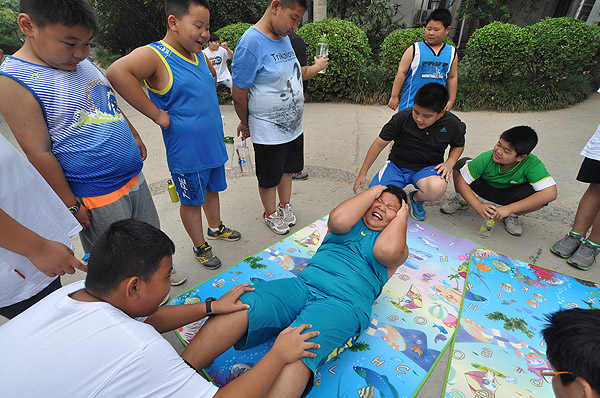
A boy struggles while doing a sit-up at a summer camp to tackle child obesity in Zhengzhou, Henan province, on July 14, 2013. [Photo by Zhang Tao/Asianewsphoto] |
Obesity is no longer a concern solely of higher income, developed countries. The prevalence of obesity and overweight has risen in all regions, including in low-income countries. Today, nearly half of all countries are struggling with both undernutrition and overweight/obesity. Indeed, undernutrition and obesity often co-exist in the same communities -- even in the same household.
Economic and social transformations, including higher incomes, in many poor and middle-income nations and the availability, at relatively attractive prices, of over processed foods have led to changes in lifestyles, including dietary habits and reduced physical activity across the globe.
Not a single country -- not one – saw declining obesity between 2000 and 2013. WHO estimates 1.9 billion overweight people, of whom a third are obese.
This involves social and economic costs that, piled on top of those resulting from malnutrition, society can ill afford to bear.
The 2013 edition of FAO's State of Food and Agriculture noted that the social burden due to overweight and obesity has doubled over the past two decades. According to the report, the cumulative cost of all non-communicable diseases, for which overweight and obesity are leading risk factors, were estimated to be about US$1.4 trillion in 2010.
More recently, the McKinsey Global Institute estimated the global price tag of obesity – including the increasing the risk of heart disease, hypertension, strokes, diabetes, and some cancers affecting the overall quality of life – could run as high as $2 trillion a year, third only to smoking ($2.1 trillion) and armed conflicts ($2.1 trillion)!
While the numbers are not comparable and the global estimates of the economic costs of obesity and overweight vary, they coincide in their scale.
Now, think of what could be done to tackle malnutrition – hunger, undernutrition, micronutrient deficiencies and obesity – if we threw that amount of money behind the effort. Increasing funding is necessary to scale up efforts, but it should be a part of a bigger effort to re-strategize our approach to tackling malnutrition in all of its forms, deepening our focus beyond the immediate causes to include the broader socio-cultural, economic and political dimensions of nutrition.
This was a challenge that was taken up at the Second International Conference on Nutrition (ICN2) in Rome in November 2014. At ICN2, governments endorsed the Rome Declaration on Nutrition and the accompanying Framework for Action, committing themselves to address the broad spectrum of malnutrition -- including undernourishment, stunting, wasting, micronutrient deficiencies, obesity and related non-communicable diseases.



I’ve lived in China for quite a considerable time including my graduate school years, travelled and worked in a few cities and still choose my destination taking into consideration the density of smog or PM2.5 particulate matter in the region.
Copyright 1995 - . All rights reserved. The content (including but not limited to text, photo, multimedia information, etc) published in this site belongs to China Daily Information Co (CDIC). Without written authorization from CDIC, such content shall not be republished or used in any form. Note: Browsers with 1024*768 or higher resolution are suggested for this site.
License for publishing multimedia online 0108263 Registration Number: 130349