 |
|
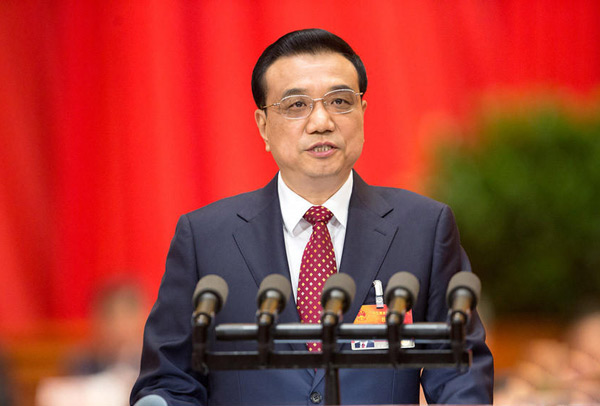
Chinese Premier Li Keqiang delivers a government work report on the opening day of the third session of the 12th National People's Congress in Beijing, March 5, 2014. [Photo/china.com.cn] |
In this year's Government Work Report, Premier Li Keqiang has repeatedly stressed the importance of innovation.
So, is there a proven approach to developing innovative capacity in an open economy? Elements of innovation strategy are measured and compared yearly by the Global Innovation Index, the self-declared "leading reference" for innovation indices. A collaborative effort by Cornell University, INSEAD and the UN's World Intellectual Property Organization, the GII takes a broad view of innovation, measuring seven analytical pillars covering capabilities (inputs) and results (outputs).
The 2014 edition of the GII, the seventh in the series, validates Premier Li's strategy by assessing, among others, innovation capacity through institutional conditions, infrastructure and market sophistication. At 29, China is the highest ranked upper-middle-income country. Indeed, this is a remarkable achievement considering the historical headstart enjoyed by many Western countries. The accompanying GII report emphasizes that China has outperformed other BRICS countries in the rankings, and predicts a continued rise. The report cites China's university and research system development as factors for its rise.
A closer examination reveals that China's 45th rank in innovation "input" pillars (including infrastructure and research) is only the fourth-best among upper-middle-income countries - behind Malaysia, Hungary and Mauritius. Conversely, China ranks 16th in innovation "output" pillars, which measure production of knowledge, technology and creativity. The latter is an improvement of nine places from the previous year and the highest among upper-middle-income countries. This difference implies that China is "doing more with less" compared with other countries.
While only recently reflected in this rankings surge, China's success is actually the result of decades of investment in research and development, which, according to the GII report, China has made at triple the rate of countries with similar income levels since the 1990s.
Nevertheless, China still has room for improvement on key sub-indices. Among the 143 countries surveyed in the GII, China under-performs in several dimensions, including ease of starting a business (122), tertiary education (115) and knowledge-intensive employment (101). It also ranks 114 in the overall institutions sub-index, which constitutes measurements of political, regulatory and business environments. And its rankings in other key innovation-related factors are moderate, including number of researchers (50), intangible assets (50) and creative goods and services (33).



I’ve lived in China for quite a considerable time including my graduate school years, travelled and worked in a few cities and still choose my destination taking into consideration the density of smog or PM2.5 particulate matter in the region.
Copyright 1995 - . All rights reserved. The content (including but not limited to text, photo, multimedia information, etc) published in this site belongs to China Daily Information Co (CDIC). Without written authorization from CDIC, such content shall not be republished or used in any form. Note: Browsers with 1024*768 or higher resolution are suggested for this site.
License for publishing multimedia online 0108263 Registration Number: 130349