|
 |
|
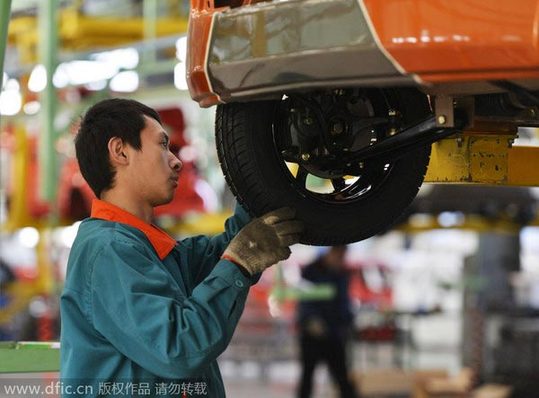
A Chinese worker assembles a new energy car on the assembly line at an auto plant in Zouping county, East China's Shandong province, Dec 16, 2014. [Photo / IC] |
The annual meeting of China’s National People’s Congress starts on Thursday.
The Congress should give us a better sense of the government’s priorities and objectives for the rest of the year. Four things are likely to be in spotlight in particular.
The first is the GDP growth target, which will be revealed in Premier Li Keqiang’s Government Work Report on Thursday.
It seems highly likely that the target will be lowered this year. It’s widely speculated that it will be set at “about 7 percent”, compared with the last two years’ target of “about 7.5%”. GDP growth had already fallen to 7.4 percent, the lower end of the government’s target range, last year and most indicators suggest that momentum has remained weak coming into this year.
Keeping the target unchanged would therefore give the government little room to manoeuvre and likely to force it to ease policy more aggressively, setting back efforts to address credit risks.
At the same time, policymakers seem increasingly comfortable with the idea that China is undergoing a structural transition to a new normal of slower growth.
This increasing willingness to accept slower growth largely reflects the fact that concerns that a slowdown would hurt employment have so far proven unfounded. China added a record number of new urban jobs last year, easily beating the governments’ annual 10 million job target. Over the past year, policymakers have continually emphasized that their primary focus is on ensuring a healthy labor market and have sought to downplay growth of GDP. As such, the government is likely to restate its 2014 target for new urban job creation in 2015.
Reform implementation is the second thing to pay attention to at the NPC, notably in the premier’s Work Report.
If the provincial Work Reports that have already been published are any guide, state sector reform is likely to be one of the main areas discussed. While many local governments have already launched their own efforts to reform state-owned companies, it is worth looking out for further details regarding a nationwide plan.
This will reportedly loosen restrictions on private investment in SOEs. Another key area to watch is financial sector reform, which is central to efforts to improve credit allocation. Last year’s Work Report pledged to establish a deposit insurance system, which was eventually unveiled in November. We will be looking to see if policymakers pledge further steps towards interest rate liberalization this year, such as gradually removing the deposit ceiling on fixed-term deposits with longer maturities.



I’ve lived in China for quite a considerable time including my graduate school years, travelled and worked in a few cities and still choose my destination taking into consideration the density of smog or PM2.5 particulate matter in the region.
Copyright 1995 - . All rights reserved. The content (including but not limited to text, photo, multimedia information, etc) published in this site belongs to China Daily Information Co (CDIC). Without written authorization from CDIC, such content shall not be republished or used in any form. Note: Browsers with 1024*768 or higher resolution are suggested for this site.
License for publishing multimedia online 0108263 Registration Number: 130349