China's growth model hinges on a governance system in which regions, cities, companies, and individuals compete within an increasingly market-oriented but still centrally regulated, economy. But in a country as large and diverse as China, a one-size-fits-all approach will not ensure that the market functions effectively. After all, different local economies have different needs.
More generally, most of the structural tools needed to strengthen market allocation - including planning, zoning, environmental standards, property rights and bankruptcy procedures - are implemented at the local level. Adding yet another layer of variability, local economies may experience "creative destruction" as their growth models change, potentially causing temporary slowdowns that drag down overall growth.
Against this background, the best way to sustain China's economic transition and prevent a hard landing is to implement looser monetary and credit policies that enable the most productive cities, companies and industries to generate new added value. With the risks of inflation and asset bubbles being mitigated by lower oil prices and excess capacity, now is a good time to initiate this policy shift.
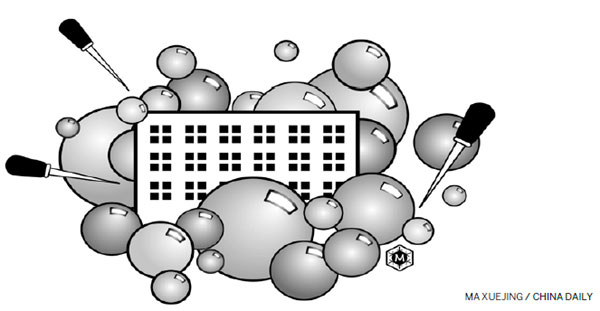
After decades of high-speed growth and policy experimentation, cyclical overshoots - reflected in excess capacity, ghost towns and local debt overhangs - are no surprise. Now it is time to address them. Only by confronting these structural issues can China complete its shift to its new, more developed and more equitable "normal".
Andrew Sheng is distinguished fellow of the Fung Global Institute and a member of the UNEP Advisory Council on Sustainable Finance, and Xiao Geng is director of research at the Fung Global Institute.
Project Syndicate



I’ve lived in China for quite a considerable time including my graduate school years, travelled and worked in a few cities and still choose my destination taking into consideration the density of smog or PM2.5 particulate matter in the region.
Copyright 1995 - . All rights reserved. The content (including but not limited to text, photo, multimedia information, etc) published in this site belongs to China Daily Information Co (CDIC). Without written authorization from CDIC, such content shall not be republished or used in any form. Note: Browsers with 1024*768 or higher resolution are suggested for this site.
License for publishing multimedia online 0108263 Registration Number: 130349