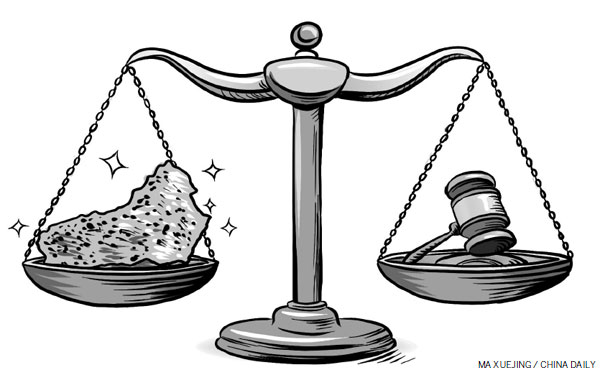
A 7.85-kilogram chunk of gold found by a herdsman in Qinghe county, Xinjiang Uygur autonomous region, last week has sparked heated discussions across the country over its ownership. Going by the Property Law, the gold surely belongs to the State because it is an "ownerless property" found within China's border.
In China all properties, be they collectively or personally owned, belong to the State, with State-owned property getting absolute State protection and personal property receiving relative protection. Besides, State ownership takes precedence in matters of controversial ownership, meaning the State has the right of ownership of unidentified properties.
The Property Law only offers a broad definition of the ownership of natural resources.
Land, minerals and water are State properties, and cannot be owned by individuals. The same rule applies to wildlife, cultural relics, defense resources and even radio-frequency spectrum. Forests, mountains, grasslands and deserts, except those belonging to collectives in accordance with the law, are owned by the State too. In other words, all visible resources can be deemed State property, with the exceptions being those specifically listed in the law as collective or personal properties.
But some law experts say the chunk of gold, partly buried in earth and dust, found by the Qinghe herdsman cannot be considered part of the country's natural resources and thus belongs to the herdsman. And at best, it can be considered lost property. But Article 111 of the Property Law says that lost property has to be submitted to a relevant department before claiming it. And Article 113 says that lost property, if not claimed by within six months of issuance of a lost property notice, should be owned by the State.
This is not to say the herdsman cannot hold the gold, which is not "lost property" in the traditional sense. But then he has to submit his find, which apparently was buried treasure, to police or some other department that have to issue a lost property notice and wait for six months for the original owner (if any) to claim it. Of course, after the passage of six months, it can be considered as State property.
It is thus clear that the Property Law is veered toward protecting State property. And citizens who find lost property or cultural or other relics are entitled to get rewards for turning them in to their rightful owners, be it the State or individual owners. But there no specific rule to decide the sum of the reward according to the value of the discovered item.
Therefore, given the existing Property Law, citizens who finds a treasure, buried or above ground, have to declare it to local governments instead of claiming their ownership. That being the case, not only the State's property but also the benefits accruing to the person who discovers it could be unwillingly damaged.
The author is a professor at Zhongnan University of Economics and Law in Wuhan, Hubei province.



I’ve lived in China for quite a considerable time including my graduate school years, travelled and worked in a few cities and still choose my destination taking into consideration the density of smog or PM2.5 particulate matter in the region.
Copyright 1995 - . All rights reserved. The content (including but not limited to text, photo, multimedia information, etc) published in this site belongs to China Daily Information Co (CDIC). Without written authorization from CDIC, such content shall not be republished or used in any form. Note: Browsers with 1024*768 or higher resolution are suggested for this site.
License for publishing multimedia online 0108263 Registration Number: 130349