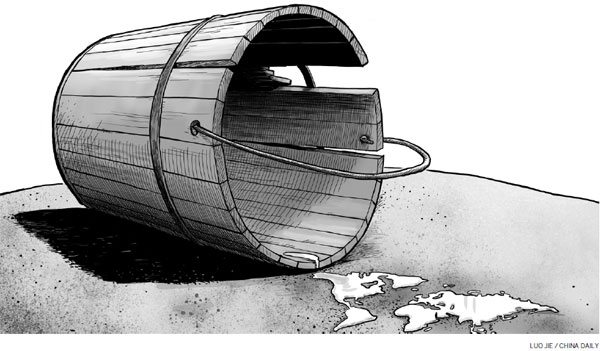
Over the past two decades climate change has steadily climbed the international political agenda, but sadly water issues have not received such attention. Climate change is indeed important. But mitigating climate change alone will not solve the water scarcity problem. Unlike the efforts needed to mitigate climate change, which is characterized by uncertainties, we know how to solve the water problem, for we have the knowledge, technologies and funds necessary for the purpose. Yet poor water management continues across the world with no signs of improvement.
Agriculture accounts for nearly 70 percent of all global water use. But there is not a single country where farmers pay the full operation and maintenance costs, let alone investment costs, for the water they use. Even for household water, people in very few cities pay the real cost of water services. With sensible water pricing, utilities can become financially viable and people can be made to use water efficiently.
For example, in Qatar, a desert country, Qatari nationals don't pay any water tariff, and expatriates pay about one-third of the cost. Qatar has one of the highest per capita water consumption in the world - about 430 liters. Add to this nearly 35-50 percent loss from the system, which means Qatar has to produce 580-645 liters of water per person per day. But on average Qatari nationals, who receive water free, use about 1,200 liters of water a day. This means on average they receive 1,620-1,800 liters water (factoring in the waste) every day. This contrasts sharply with a Hamburg resident who uses about 110 liters a day.
Poor water management over decades has created numerous structural problems. The Aral Sea used to be the world's fourth largest freshwater lake. The diversion of two rivers, Amu Darya and Syr Darya, which provided it with a steady flow of freshwater, for cotton production, has reduced it to only a small shadow of its glorious self.
Take China as another example. In the 1950s, it had 50,000 rivers that had a catchment area of 100 square kilometer or more each. By 2013, the number of such rivers had reduced to 27,000. Many rivers have simply disappeared because of overuse by agriculture and industry.



I’ve lived in China for quite a considerable time including my graduate school years, travelled and worked in a few cities and still choose my destination taking into consideration the density of smog or PM2.5 particulate matter in the region.
Copyright 1995 - . All rights reserved. The content (including but not limited to text, photo, multimedia information, etc) published in this site belongs to China Daily Information Co (CDIC). Without written authorization from CDIC, such content shall not be republished or used in any form. Note: Browsers with 1024*768 or higher resolution are suggested for this site.
License for publishing multimedia online 0108263 Registration Number: 130349