 |
|
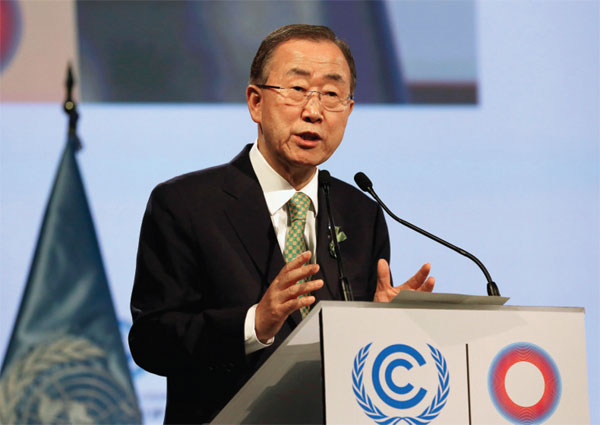
United Nations Secretary-General Ban Ki-moon gives a speech during the opening of the High Level Segment of the UN Climate Change Conference COP 20 in Lima on Tuesday. Mariana Bazo / Reuters |
US President Barack Obama again praised the landmark China-US climate deal in his State of Union address. China's extensive coal-burning factories and auto emissions are widely blamed for the poor quality air in the country, but one important sector is often overlooked - its runaway real estate sector.
A staggering 40 percent of global greenhouse gas (GHG) emissions come from buildings, and China's rapid economic growth and ambitious urbanization plans have spurred equally rapid construction. Within China's reach is one of the biggest levers to limit carbon emissions, that is, improving energy efficiency in new and existing buildings.
Under President Xi Jinping's new urbanization plan, China will build more than half of the world's new buildings to accommodate 100 million people relocating from the countryside to cities over the next six years. As a result, the total building energy consumption and commercial floor space are expected to double by 2050. China currently has 50 billion square meters of buildings, and will add another 2 billion sqm each year.
China can turn this situation to its advantage. As Hank Paulson, chairman of the Paulson Institute and former US secretary of treasury has said: "If China is able to reduce the energy footprint of its buildings - commercial, residential and industrial - the savings would be greater in reducing GHG emissions than those from all other energy-using sectors combined."
Recommendations focus on the need for practical and readily implementable solutions that will make a significant difference. Here are specific steps that China can take:
Deploy existing technologies: Low cost technology available today could reduce energy inefficiencies by 30 percent or more, according to the Rocky Mountain Institute and Lawrence Berkeley National Labs. For older buildings, retrofittings can yield an energy cost savings payback in about three years. Even installing insulation can yield immediate and significant reductions in energy consumption.
Strengthen the underlying legal infrastructure: Building-code standards that reflect the latest technological innovations and are updated on a consistent and regular basis, and vigorously enforced could promote efficiencies of up to 30 percent.



I’ve lived in China for quite a considerable time including my graduate school years, travelled and worked in a few cities and still choose my destination taking into consideration the density of smog or PM2.5 particulate matter in the region.
Copyright 1995 - . All rights reserved. The content (including but not limited to text, photo, multimedia information, etc) published in this site belongs to China Daily Information Co (CDIC). Without written authorization from CDIC, such content shall not be republished or used in any form. Note: Browsers with 1024*768 or higher resolution are suggested for this site.
License for publishing multimedia online 0108263 Registration Number: 130349