 |
|
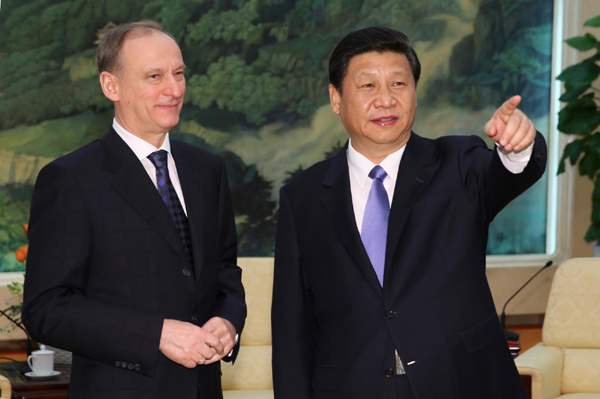
Xi Jinping (R), general secretary of the Communist Party of China Central Committee, meets with Russian Security Council Secretary Nikolai Patrushev in Beijing, capital of China, Jan 8, 2013. [Photo/Xinhua] |
Which relationship is more important for China, that with the United States or with its neighbors?
The Chinese authorities used to be quite ambiguous on the question by stating both are essential, but with the nation's rise and growth in comprehensive capabilities, it is necessary to give a clear answer.
The question has arisen because of a geopolitical fact, namely the US as the only superpower in this world is not one of China's neighbors. It is a common view among certain scholars that the US should be the key part of China's diplomacy, because if the relationship is improved, China's rise would not meet any effective resistance. For others, peripheral diplomacy is more essential because without its neighbors' support China's rise will be a bubble.
To better answer the question of which one is more important, it is necessary to first analyze China's rise. Historically, all global powers rose as regional powers before becoming global powers. In the early stages of its rise, the US implemented the Monroe Doctrine and focused on Latin America; after World War II, the Soviet Union, which was growing in strength, took Europe as the focus.
China will be no exception, so it too needs a successful neighborhood policy first. That move can help win friends among its neighbors, because after World War II it is already an established rule that sovereignty and territory should not be violated; both the US and the Soviet Union influenced neighbors' politics but without incorporating territory as they had done in the past.
A successful peripheral policy is also needed because the US will almost certainly try and block China's rise. Structural conflicts are almost certain between a rising power and an existing one; the US leaders' words and deeds have confirmed this principle of modern international relations theory. China needs to rally support to counterbalance the pressure.
A good peripheral policy will help China rally the needed support from its neighbors, because they can benefit from China's rise. Two good examples are the Republic of Korea and Thailand, both of which have adopted favorable policies toward China following its growing comprehensive capabilities. China needs to cultivate more friends in the neighborhood.
A proper peripheral policy will also help avoid overexpansion, a common mistake that led to the decline and even downfall of many rising powers. Besides historical empires, the US too has shown signs of comparative decline over the past decade and many scholars attribute that to its overexpansion in the Middle East. If China's ambitions get too big and cover too many parts of the globe, it might suffer in the same way.



I’ve lived in China for quite a considerable time including my graduate school years, travelled and worked in a few cities and still choose my destination taking into consideration the density of smog or PM2.5 particulate matter in the region.
Copyright 1995 - . All rights reserved. The content (including but not limited to text, photo, multimedia information, etc) published in this site belongs to China Daily Information Co (CDIC). Without written authorization from CDIC, such content shall not be republished or used in any form. Note: Browsers with 1024*768 or higher resolution are suggested for this site.
License for publishing multimedia online 0108263 Registration Number: 130349