 |
|
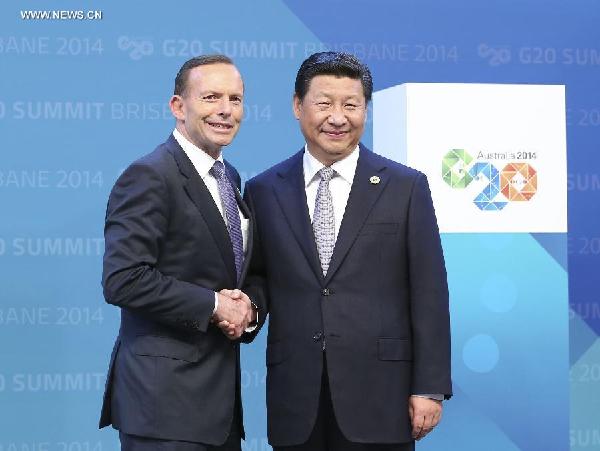
Chinese President Xi Jinping (R) is welcomed by Australian Prime Minister Tony Abbott at the 9th Group of 20 (G20) Summit in Brisbane, Australia, Nov 15, 2014. [Photo/Xinhua] |
The history of international economic cooperation teaches us one important lesson: every form of cooperation will die, essentially if not formally, if it does not adapt to new conditions. Now that China has risen to global power status, have the global institutions adapted to the new situation or are they on the verge of losing their relevance, perhaps even dying, because their incumbent powers are reluctant to change?
The past 20 years have witnessed huge shifts not only in what issues international economic cooperation should address, but also in the conditions for effective cooperation.
Importantly, the Cold War, with its ideological conflict between two different ideas of economic and societal order, provided the glue that kept many of these organizations together after their initial post-war purpose had been achieved. The United States had strategic reasons to provide leadership for the global economy, and Europe conformed, sometimes reluctantly, to that leadership. They aimed to spread the principles of the market economy and the role of free trade to generate peace and prosperity.
But that era is now over. Now it is a case of finding mechanisms for old, new and future global powers to collaborate. So what does the progress report say on how that endeavor is going?
Not very well; catastrophes have been avoided but on the current trend, the world's economic institutions are slipping into obscurity.
The good news is that key global powers managed to come together in 2008 and 2009 to prevent the global economy from slipping into a new Great Depression. Even if the crisis response was far from optimal, countries did what was necessary and they halted the crisis from spreading from the West to the East.
The not-so-good news is that there is no new formula for leadership in global institutions such as the World Bank, the World Trade Organization or the International Monetary Fund. All global powers share a responsibility for making these institutions effective, but in the past years most countries have chosen to neglect that responsibility.
European governments have had great trouble accepting that shared responsibility for global economic institutions inevitably means diminishing power and influence for Europe. In fact, European countries, not the United States, are the main losers of power in global institutions, if they are to reflect the real economic power balance in the world. Their role in the World Bank and the IMF will only decline farther as "shares and chairs" in these institutions better reflect the shares that European countries have in the global economy.



I’ve lived in China for quite a considerable time including my graduate school years, travelled and worked in a few cities and still choose my destination taking into consideration the density of smog or PM2.5 particulate matter in the region.
Copyright 1995 - . All rights reserved. The content (including but not limited to text, photo, multimedia information, etc) published in this site belongs to China Daily Information Co (CDIC). Without written authorization from CDIC, such content shall not be republished or used in any form. Note: Browsers with 1024*768 or higher resolution are suggested for this site.
License for publishing multimedia online 0108263 Registration Number: 130349