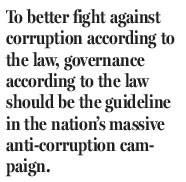
That means, such norms should elaborate not only the punishments for corruption, but also specific regulations and restrictions on the exercise of public power. Party discipline, the administrative regulations and the laws should better coordinate to keep corruption in check.
For the moment, the anti-graft regulation systems may have loopholes that might be easily exploited by corrupt officials dreaming of getting away with their misconduct, and improved coordination is needed to deal a heavy blow against corruption.
To be specific, the Party's discipline needs to stress the importance of the ethnics and obligations of its members, especially public servants, need to abide by. In addition, the legislation needs to lower the bar in defining what constitutes a crime of corruption, and include cases which currently are only contradictory to the Party discipline in the anti-corruption campaign.
Admittedly, the revised Chinese Criminal Procedural Law has made notable breakthroughs in stipulating the special investigative measures. Yet, it has actually achieved little in solving a slew of key problems, for example, the lack of general standards for defining crimes of corruption, and cross-border extradition and assets recovery.
Moreover, judicial operation calls for a mechanism under which the People's Procuratorate, People's Court, and the Central Commission for Discipline Inspection cooperate to ensure checks and balances.
China's anti-corruption efforts today, in accordance with CPC discipline and the Chinese criminal justice, will unavoidably require both the Party's discipline inspection organs and the country's judicial organs to function effectively. In certain cases, the former should be strict in intra-party regulations, while the latter should uphold fairness and justice.
The author is the director of the China Anti-Corruption Judicial Research Center in Beijing.



I’ve lived in China for quite a considerable time including my graduate school years, travelled and worked in a few cities and still choose my destination taking into consideration the density of smog or PM2.5 particulate matter in the region.
Copyright 1995 - . All rights reserved. The content (including but not limited to text, photo, multimedia information, etc) published in this site belongs to China Daily Information Co (CDIC). Without written authorization from CDIC, such content shall not be republished or used in any form. Note: Browsers with 1024*768 or higher resolution are suggested for this site.
License for publishing multimedia online 0108263 Registration Number: 130349