 |
|
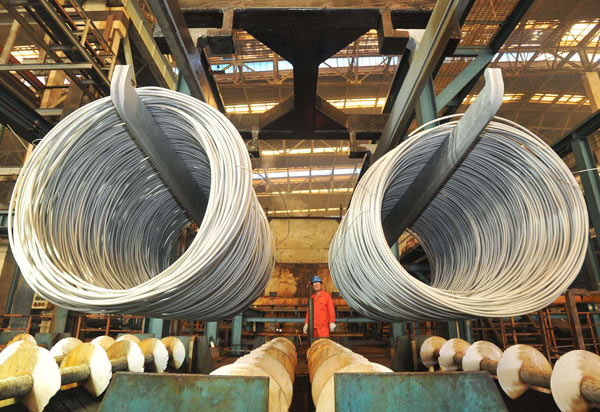
With infrastructure projects booming, Latin America has been buying more steel from China, which is coping with surpluses. [Photo/Provided to China Daily] |
The first China-Latin America and the Caribbean (LAC) Foreign Ministers' Forum will take place in Beijing on Jan 8-9. Four heads of government, some 30 foreign ministers and 40 delegations will descend upon the Chinese capital for a major international gathering that will kick off China's diplomatic calendar year. They will be following up on the commitment taken up in Brasilia, Brazil, last July during the visit of President Xi Jinping to institutionalize Sino-LAC links and deepen this relationship across the Pacific.
For LAC, the first decade of the 21st century was marked by the boom of the Asian economies, particularly by that of China. Trade flows between the Asia-Pacific region and LAC grew by 20.5 percent a year between 2000 and 2010, with two-way commerce reaching $442 billion in 2011, of which China accounts for half. By now, Asia accounts for 21 percent of LAC's foreign trade, trailing only the United States with 34 percent.
Trade with China saw a real explosion, increasing from $10 billion in 2000 to $257 billion in 2013, a surge of 2,500 percent. By 2011, China had become the largest export market for Brazil, Chile and Peru, and the second-largest for Argentina, Venezuela, Cuba and Uruguay. As the World Bank observed in 2011, "the robust growth in LAC in the past decade is in an important measure due to its connections to China". The impact on economic growth was direct, through China's huge demand for primary commodities such as copper, iron ore and crude oil, and foodstuffs such as soy and fresh fruits to fuel its rapidly growing economy and feed its now prosperous population of 1.3 billion. China's impact was also indirect, through upward pressure on commodity prices.
Now that the Chinese economy is settling into the new normal, growing at 7 percent rather than 10 percent, commodity prices have softened, and the LAC economies have felt the impact. LAC's projected 2014 growth is 1.3 percent, a far cry from the 5 percent it averaged in 2003-08.
The truth is, 2014 was a very turbulent year, and the sharp drop in oil prices especially affected some of LAC's largest economies. But the fundamentals of Sino-LAC links, the degree to which the Chinese and the LAC economies complement each other, remain as solid as ever. With 20 percent of the world's population and only 7 percent of its fresh water, China will depend more and more on food imports, prominently from LAC, as well as on other natural resources.



I’ve lived in China for quite a considerable time including my graduate school years, travelled and worked in a few cities and still choose my destination taking into consideration the density of smog or PM2.5 particulate matter in the region.
Copyright 1995 - . All rights reserved. The content (including but not limited to text, photo, multimedia information, etc) published in this site belongs to China Daily Information Co (CDIC). Without written authorization from CDIC, such content shall not be republished or used in any form. Note: Browsers with 1024*768 or higher resolution are suggested for this site.
License for publishing multimedia online 0108263 Registration Number: 130349