There will be little rejoicing over this weekend's Japanese election. Prime Minister Shinzo Abe remains the leader of his party and his country. But very few can imagine him winning a single popularity contest anywhere in the neighborhood of East Asia. No wonder, the Japanese people are not exactly reacting in wild kanpai-yelling celebrations.
This was an election without elation.
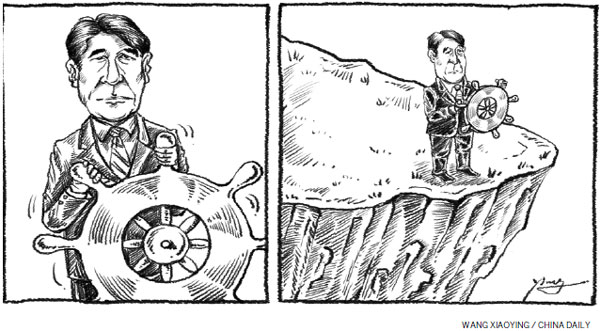
But where does Abe take Japan now?
Consider that his "blue-blood" genes are embedded in nationalistic DNA: His career-diplomat father was foreign minister (1982-1986) under the transformative prime ministership of Yasuhiro Nakasone and his mother's father was a deeply controversial prime minister who had served in Hideki Tojo's wartime cabinet. The worry is that Abe's roots offer dangerous strands of nationalism, fundamentalist values and militarism.
While clearly the man of the moment, Abe may also be understood as Japan's leader mainly by default. The opposition is in such a pathetic shambles that the polity has reverted back to little more than a one-party deal. Many Liberal Democratic Party voters took the resigned, pragmatic view that some kind of national leadership was preferable to none at all. Landslides are easier when the opposition is vacuous.
The domestic vacuum could make Abe more consequential abroad as well as at home. The world's stake in Japan's future is anything but peripheral. It remains the third-largest economy - ahead of Germany, France and the United Kingdom. If its political system now resembles what Americans, half-jokingly, would call an Edsel (the famous iconic auto failure in US corporate history), economically it can still shine like a Lexus. Everyone accepts that China's own economic rebirth would have been more difficult without productive and consuming neighbors like Japan, not to mention the Republic of Korea (and of course faraway United States).
For the foreseeable future, Japan remains the US' default Asian ally, its first go-to option. US opinion polls reaffirm support for that. In fact, the American public views this important society of talented people as the centerpiece of US-Asia security. But that sense of need could weaken if the Abe government becomes known for a policy of aggressive nationalism, which will trigger overwhelming regional pushback, as well as economic policies that backfire by shrinking Japan further.
 Considering money as the end is the tragedy

Copyright 1995 - . All rights reserved. The content (including but not limited to text, photo, multimedia information, etc) published in this site belongs to China Daily Information Co (CDIC). Without written authorization from CDIC, such content shall not be republished or used in any form. Note: Browsers with 1024*768 or higher resolution are suggested for this site.
License for publishing multimedia online 0108263 Registration Number: 130349