|
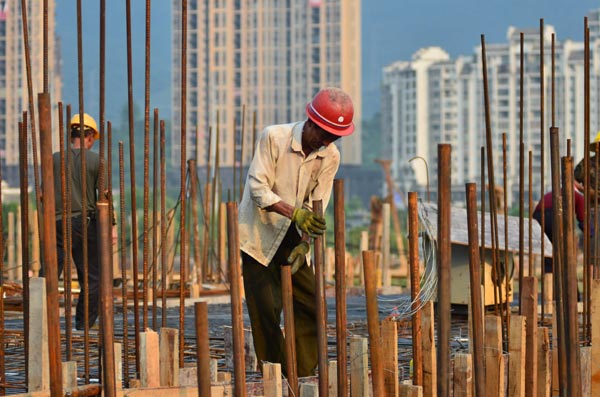 Workers at a property project in Chenzhou, Hunan province. Property developers are facing the pressure of a decline in net profits in the first half of 2014. [Photo/China Daily] |
After the reform and opening, China’s urbanization progressed from a low starting-point to an unparalleled speed. From 1978 to 2013, the number of people living in cities increased from 170 million to 730 million and, with an annual increase of 1.02 percent, the urbanization rate went up from 17.9 percent to 53.7 percent. According to the latest development strategy published in 2014 for the urbanization from 2014 to 2020, urbanization is still an indispensable part of National Development Plan. The unprecedented prosperity of modern cities has absorbed gigantic amount of labor force from suburban areas, boosted the overall economy, improved the efficiency of the allocation of production factors, and initiated profound revolution of social structures.
However, because of the long existing binary structure of social economy, China’s urbanization is still not effectively compatible with the economic and social development. Urbanization is still lagging behind industrialization and modernization. One of the reasons of such phenomenon is financial repression.
Financial repression, first introduced by American economists Edward S. Shaw and Ronald I. McKinnon, is any of the measures that governments employ to channel funds to themselves, that, in a deregulated market, would go elsewhere. Based on the critique of the traditional monetary theory and Keynesianism, Shaw’s theory demonstrated that finance and economy not only encouraged but also constrained each other at the same time.
Financial repression in developing countries refers to the phenomenon that a country lacks a well-developed financial market and has overly excessive restraints on such market. In current China, financial repression has been characterized as consisting of such key elements as interest rate control, inefficiency of the financial market, imperfect financial institutions and immature capital formation mechanism.
During the first half of 2014, Chinese lenders have raised a record amount of funds offshore, showing a capital need that is stronger than ever. Confronted with this situation, China’s financial market is still facing challenges to provide sufficient funding and further changes are needed.


Copyright 1995 - . All rights reserved. The content (including but not limited to text, photo, multimedia information, etc) published in this site belongs to China Daily Information Co (CDIC). Without written authorization from CDIC, such content shall not be republished or used in any form. Note: Browsers with 1024*768 or higher resolution are suggested for this site.
License for publishing multimedia online 0108263 Registration Number: 130349