|
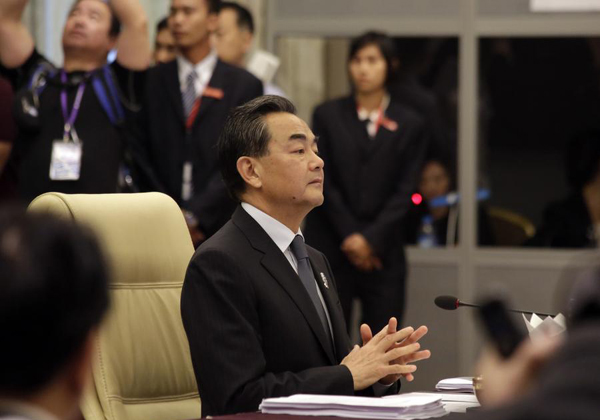 Chinese Foreign Minister Wang Yi attends China and Association of Southeast Asian Nations in Nay Pyi Taw on Saturday. [Photo/Xinhua] |
BEIJING - This weekend saw top diplomats of the world's two largest economies, the United States and China, engage in a head-on clash over the South China Sea issue.
Chinese Foreign Minister Wang Yi rebuffed a call by US Secretary of State John Kerry for a "freeze" on provocative actions in the South China Sea at an ASEAN foreign minister's meeting in Myanmar.
Kerry's proposal sounds good but may be counterproductive in effect. It is simply an unconstructive idea.
In the first place, it exaggerated the maritime tensions in the region and would complicate the ongoing efforts by relevant parties to calm down the waves in the South China Sea.
Despite a recent confrontation between Beijing and Hanoi over China's deployment of an oil rig in its own waters, the overall situation in the sea remains stable and poses no major risk of spiraling out of control.
In particular, the US worry over maritime safety is unwarranted since the freedom of navigation has been fully guaranteed.
By stoking the flames, Washington is further emboldening countries like the Philippines and Vietnam to take a hardline stance against China, raising suspicion over the real intention of the United States and make an amicable solution more difficult to reach.
It can hardly be accepted as a coincidence that the previously calm South China Sea has lost its tranquility since the United States embarked on its pivot to Asia strategy.
Rejecting the US proposal does not mean China will not behave itself. On the contrary, China has so far exerted maximum restraint in its territorial and maritime disputes with some ASEAN countries and has been consistent in seeking a negotiated solution on a bilateral basis.
Beijing is also working with the ASEAN bloc on the formulation of a Code of Conduct to ensure regional peace and stability, which serves interests of all countries in the region as well as the United States.
All these efforts made by countries directly involved are the best way to solve the disputes, rather than a proposal by an outside interested party, who claims neutrality but often adopts double standards in the disputes.
China has always welcome the United States playing a constructive role, but what Washington said and did was sometime pitifully unconstructive.
It is worth noting that the overall relationship between China and ASEAN is solid and flourishing, which has brought enormous benefits to the people on both sides.
There is a common recognition that the good momentum should not be interrupted by the disputes between China and some ASEAN members.
It is a painful reality that Uncle Sam has left too many places in chaos after it stepped in, as what people are witnessing now in Iraq, Syria and Libya.
The South China Sea should not be the next one.


Copyright 1995 - . All rights reserved. The content (including but not limited to text, photo, multimedia information, etc) published in this site belongs to China Daily Information Co (CDIC). Without written authorization from CDIC, such content shall not be republished or used in any form. Note: Browsers with 1024*768 or higher resolution are suggested for this site.
License for publishing multimedia online 0108263 Registration Number: 130349