World War I broke out on July 28 exactly 100 years ago. It claimed more than 9 million combatants' lives, the second deadliest war in history.
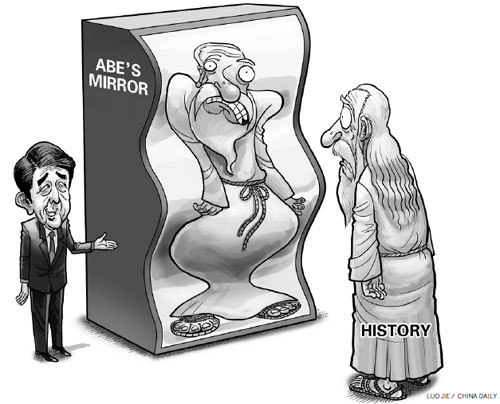
Referring to the events that led to the Great War, Japanese Prime Minister Shinzo Abe has likened the tensions between Japan and China to the relationship between Germany as a rising power challenging the United Kingdom 100 years ago. He certainly had a point when he said that trading relations and investments couldn't stop the brewing conflict in Europe a century ago from engulfing the world in war.
People throughout Asia must reflect on the hard lessons Europeans have learned from the two world wars. Europeans are revisiting the Great War, which broke out 100 years ago when a Bosnian Serb named Gavrilo Princip assassinated Archduke Franz Ferdinand, heir presumptive to the Austro-Hungarian throne. The failure of the European leadership to prevent the war brought calamity to Europe.
Domino-style, the war saw one major empire after another tumble, beginning with the Russian empire, and followed by the Austro-Hungarian and the Ottoman empires. The war also destroyed the foundations of the global economy and European governance. Fascism and dictatorships followed in the 1930s, leading to World War II and the Cold War.
In East Asia leaders can learn from these lessons, and never forget that economic relations cannot prevent a war. The real challenge - in Europe 100 years ago and in Asia today - is how to turn enmity into amity. Then as now, the best way to proceed is to begin with small steps in the resolution of disputes. This is where Abe must do much more than implicitly point the finger at China.
There is no denying that China suffered humiliation at the hands of Japan in the 1894-95 Sino-Japanese War and that the imperial Japanese army unleashed a reign of terror in China after it invaded the country in the 1930s. Given the absence of an apology from Japan, it's little wonder that Japan's militarist past continues to feed anger in China.
This is part of the sentiments that are surfacing in the competing claims for the Diaoyu Islands (Senkaku Islands in Japanese) in the East China Sea. Japan's refusal to own responsibility for the Nanjing Massacre and Abe's visit to Yasukuni Shrine that honors 14 class-A war criminals remain significant symbols of injustice for China.
Unlike the cultural context of Europe that respects apologies for the suffering caused by Nazi Germany during World War II, Japan seems to be caught in a cultural whirlpool in which apology is associated with shame.
In 1999, then-German president Johannes Rau apologized to the victims of Nazi Germany, which was respected by the millions of victims who survived fascism. Reconciliation over the bitter events of World War II would be ideal, but unfortunately all the issues cannot be resolved in a given timeframe.
So Chinese, Japanese and other regional leaders should eschew the use of force to resolve the issues. Instead, they should engage with each other to clarify narratives, promote mutual understanding, and prevent xenophobic nationalism from taking over the regional agenda and force the region into another era of conflict.
The author is the Henry Kissinger Professor for Governance and International Security at the University of Bonn Germany, an expert on Germany and a retired US career diplomat.


Copyright 1995 - . All rights reserved. The content (including but not limited to text, photo, multimedia information, etc) published in this site belongs to China Daily Information Co (CDIC). Without written authorization from CDIC, such content shall not be republished or used in any form. Note: Browsers with 1024*768 or higher resolution are suggested for this site.
License for publishing multimedia online 0108263 Registration Number: 130349