Chinese characters have evolved over thousands of years. The quintessence of Chinese civilization and culture has thus been handed down from generation to generation. But they do not only express Chinese words in written form – as they also convey traditional and philosophical thoughts.
Let’s take a look at some examples of characters and the way they are composed to express various ideas.
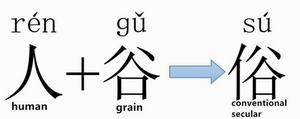
1, 俗 meaning “conventional” or “secular”. The left radical of the character refers to a “human being”, a “person”, 人, and the right part 谷means “grain” or “millet”.
The idea of people living on grain and millet conveys a sense of living a conventional life. Who can run away from the reality of the human condition unless you are an immortal? We may get detached inwardly but we still have to deal with basic necessities – whatever our status or profession – we have to conform in some way. We all have to eat to survive – so there are some basic facts that unite all human beings around the globe.
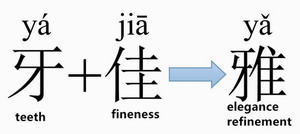
2. The second is 雅, meaning “elegance” or “refinemen”t. It includes the left radical 牙m(xù)eaning “teeth” and the right one 佳 “perfection”, which indicates that to be elegant and refined you must first eat – so refinement is actually linked to basic necessities such as eating, and to be a refined person, you must first be down-to-earth.
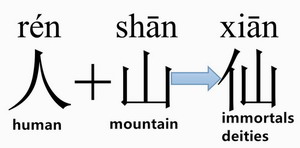
3. The character 仙 refers to “immortal” or “deity”, and it consists of 人, the character for “person”/ “human”, plus 山, “mountain”. It thus conveys that a person living on a mountain is not constrained by a life chasing material possessions - and is in fact shielded from everyday disturbances and annoyances. A person who is like a hermit may even live a lifestyle similar to an immortal/deity. It thus seems that immortals are seen as humans - but with a more cultured outlook.
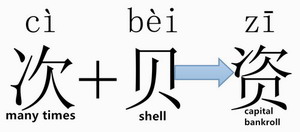
4. This character資, which means capital or bankroll includes the character 次 and also貝. The former means “multiple’ or “many times,” and the latter refers to “shells” which were used as currency in ancient times. Money must circulate - it should be used many times – and not simply saved at home.
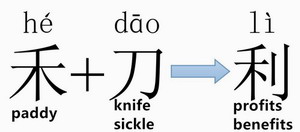
5. The character 利 refers to profits in Chinese, and the left section is 禾, meaning “paddy” while the right side is derived from the character刀 which means “knife” or “cutter”. Therefore, it literally means using a sickle to reap rice, which thus also means that we must work in a bid to reap profits and benefits.
This is perhaps a little like the saying in English: No pain, no gain. Additionally, knives, daggers or even sickles can also be used to hurt people. So this character also seems to warn us that we must not try to make money by any means available – without thought of the consequences or without thinking about morals.
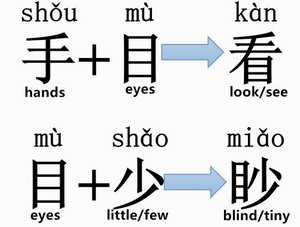
6. The character看, means “to look” or “see”, and includes the upper part 手 which means “hand” and the lower part 目 which means “eye”.
This refers to a universal gesture – sometimes people looking at something put a hand above their eyes. As the hand does not cover the eyes, the gesture/character implies that we are forward-looking and we aim to broaden our horizons.
On the contrary, we are short-sighted – or narrow-minded - if we fail to see beyond our nose.
And the kind of person – who is narrow-minded and unworldly – is described with this character眇, which means “blind” or “tiny”. Specifically, the left目 means “eye” – as mentioned above - while the right part 少 means “a little” or “few”.
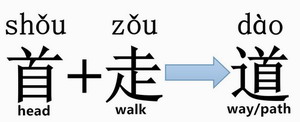
7. You have likely heard of the Chinese classic Tao Te Ching by Lao Zi, the founder of Taoism. The character 道 “Tao” means “way” or “path”. It consists of 首 which refers to “head” and the pictographic form of走 meaning “walk”.
The character seems to suggest that we should go out and see the world and thus become more enlightened.
Fantasy and daydream don’t make any sense nor do any good. Even Confucius, the widely-acknowledged saint of ancient China, has traveled through various states in the vast territory, not to mention each and every of us. Let’s end the explanation of this character with the famous quotation from Tao Te Ching. “ The Way that can be mapped is not the Eternal Way. The Nature that can be named is not the Eternal Nature.
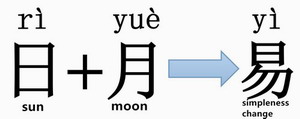
8. Another ancient classic which may be familiar to you is I Ching or The Book of Changes. The character 易 refers to “I” or “yi” of I Ching, translated as “changes”. The character is composed of 日meaning the “sun” and月, the “moon’. The two elements of the nature refer to the Chinese traditional and philosophical concept of Yin and Yang, Yin and Yang are two constantly moving elements and 易 means “continued changes”. Another meaning of 易is “simpleness” or ”easiness”. It means that we should not ignore changes – even if they are small.
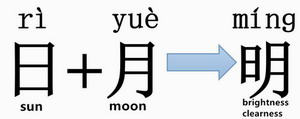
As we saw above, the upper日 and lower 月 form 易. However, a left 日and a right 月 constitute another character, 明, which means “brightness” and “clearness”. The character thus represents positive and negative. To understand something, we should first grasp the meaning of both sides and then we can gain an overview – a real understanding.