Throughout the world, transport fares are the concern of not only transport operators, but also commuters. A fare policy determines the amount of subsidies a public transport agency needs to cover its operation costs. It also determines which modes of transport people use and how many cars are on the streets.
This means a new fare policy in Beijing could drastically change the ways the surface and underground transport systems functions. So why do authorities want to increase transport fares?
Beijing subway yields relatively low revenue because of the flat fare of 2 yuan ($0.32) for one trip (which could extend from 500 meters to 88 kilometers - not including the airport line), creating a fiscal burden on the subway operators. It also affects the efficient allocation of resources, because without charging the appropriate fees for a service it is difficult to determine its true demand and, hence, the areas in which it needs improvements.
Across the world, the prevalent trend is to tap the revenue potential in the transport sector and thus not to keep fares low. For example, the London tube charges £4.50 ($7.7) for one trip within zone 1 (£2.10 for Oyster card holders). Similarly, in Hong Kong, the MTR charges between HK$4 ($0.51) and $46 a trip.
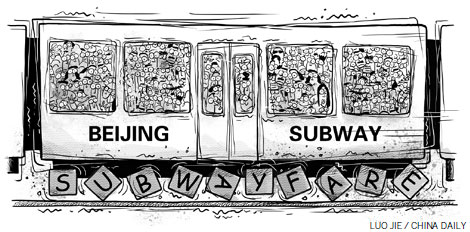
Fare pricing plays an important role in rationalizing passengers' behavior, particularly their choice between subways and buses. Given the 2-yuan fare in Beijing, some subway lines have to cope with passenger flows that exceed the capacity by up to 144 percent during peak hours, almost comparable to 171 percent in Japan - the world's most congested subway system. In contrast, Beijing's buses still have a supply surplus; according to rough estimates the existing fleet of buses could serve an additional 4 million passengers a day.
A reasonable fare structure, therefore, could prompt some price-sensitive commuters to use buses, or change their commuting timings or destinations, and thus ease the pressure on the metro.
But any increase in subway fares has to be justified in terms of social equity and benefits. An increase in fares would create social equity concerns, because mostly low-income people rely on public transport to commute to and from work. Besides, high subway fares could encourage more people to use cars, leading to more congestion and air pollution.


Copyright 1995 - . All rights reserved. The content (including but not limited to text, photo, multimedia information, etc) published in this site belongs to China Daily Information Co (CDIC). Without written authorization from CDIC, such content shall not be republished or used in any form. Note: Browsers with 1024*768 or higher resolution are suggested for this site.
License for publishing multimedia online 0108263 Registration Number: 130349