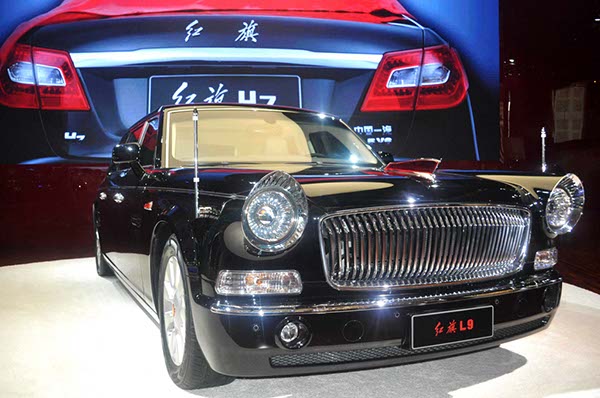
The four People's Liberation Army headquarters published a circular, approved by President Xi Jinping and the Central Military Commission, in January saying the purchase of new military vehicles should be made according to a centralized system and the armed forces need to choose domestic automobile brands. Following the circular, the PLA purchased more than 1,000 Hongqi H7 sedans made by First Automobile Works. And before the Hongqi sedans, it bought Trumpchi from Guangzhou Automobile Group and Besturn from FAW Group in deference to the central leadership's call for promoting frugality and cutting waste.
Although the PLA's move will not have an immediate effect on the auto market, it will boost China's auto industry in the long run. China became the world's leading automobile manufacturer in terms of output in 2010, ending the pole position held by the United States for more than a century.
Today, as the largest equipment manufacturer, China has an output that accounts for one-third of the world's total. It has also become the largest auto producer, as well as the largest auto market in the world. China is thus well positioned to facilitate the development of domestic auto brands, and it should embark on that because the growth of self-owned brands holds the key to sustaining its economic and social development. Based on the premise of ensuring efficiency, fair competition and clean governance, giving priority to domestic brands when purchasing vehicles for official use will not only reduce costs, but also have a far-reaching impact on the domestic auto industry.
Moreover, the PLA's purchase of domestic brand vehicles for official use is also expected to facilitate their growth overseas. International trade is an interactive process involving both the domestic and foreign markets of a trading nation. In many cases, an emerging manufacturing sector, because of insufficient effective demand at home, has to first tap overseas markets to seek the economies of scale and unleash its potential for growth.
But the lack of brands, technologies and marketing channels forces many enterprises to lower their export prices and subsidize their strategy of entering overseas markets with the profits made at home. But after the export-led growth model is established and growth in the size of domestic market, the trading nation will reach a point where it has to rely on the domestic market to better position itself in global trade. This is exactly the case with China now that it has become the world's top manufacturing country by output.
Along with the robust development of the domestic auto market, China's auto exports have increased rapidly over the last decade. General Administration of Customs' figures show that China exported 43,490 vehicles and automobile chassis worth $261 million, and auto parts worth $1.84 billion in 2002. In 2013, however, China exported 920,000 vehicle units worth $12 billion and auto parts worth $29 billion - excluding the value generated from the export of engines, tires and other auto accessories.


Copyright 1995 - . All rights reserved. The content (including but not limited to text, photo, multimedia information, etc) published in this site belongs to China Daily Information Co (CDIC). Without written authorization from CDIC, such content shall not be republished or used in any form. Note: Browsers with 1024*768 or higher resolution are suggested for this site.
License for publishing multimedia online 0108263 Registration Number: 130349