 |
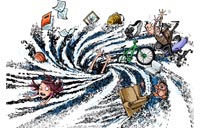
| Escape from the vortex |
|
|
Take the famous Three Kingdoms saga. To show Liu Bei in a positive light, his archenemy Cao Cao had to be made a villain, complete with a white face (in Chinese traditional opera a white face denotes either a clown or an evil person). Never mind that in historical records Cao was a capable leader of great complexity.
In the same story, the two military counsels who worked together to defeat Cao were heightened to show their contrast. In real history, both Zhou Yu and Zhuge Liang were leaders of extreme intelligence and the former played the pivotal role. But in fictionalized accounts familiar to generations of Chinese, the former was turned into a petty, jealous person while the latter was given almost supernatural powers.
Because reality usually does not lend itself to operatic proportions, Chinese writers and artists (and journalists) tend to hype up or even make up certain details to get the point across. If an adult jumps into a lake to save a child, he has done a mere "good deed"; if he saves three kids with his last breath and drowns, he has performed an act of heroism. To go one step further, if it's a child who saves three other children and drowns, he'll be made into a martyr and there will probably be a national campaign to extol him, with his image plastered throughout the nation's classrooms. I grew up with many such posters.
When I returned to China in the late 1990s, I was surprised to read about teachers calling for an end to such campaigns. They said children should not be encouraged to risk their own lives in such situations. Instead they should ask for help from adults. While it is honorable that some kids give up their own lives to save others, this kind of heroism should not be emulated by other children, they insisted.
The refusal to see real life as a facsimile of melodrama is a sign of the increasing maturity of Chinese society. Tales of unmitigated heroism have met with more and more suspicion in recent years. People question the integrity of the reporting and, if verified, the mental health of the people featured in the stories. If someone is unable or unwilling to help his own family, they reason, how could he possibly extend a hand to strangers?


Copyright 1995 - . All rights reserved. The content (including but not limited to text, photo, multimedia information, etc) published in this site belongs to China Daily Information Co (CDIC). Without written authorization from CDIC, such content shall not be republished or used in any form. Note: Browsers with 1024*768 or higher resolution are suggested for this site.
License for publishing multimedia online 0108263 Registration Number: 130349