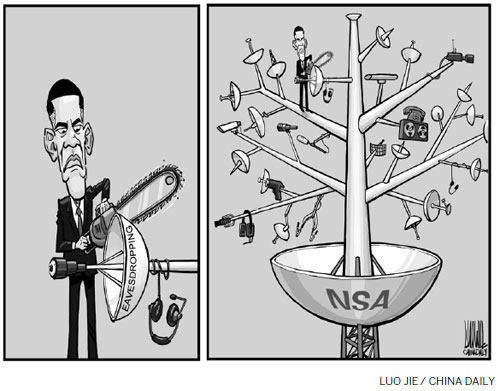
In consideration of the complexity of the international counterterrorism campaign, it is understandable that the US or other countries engaged in some cross-border actions to strike against terrorists. But in the name of counterterrorism the US is wantonly engaged in spying on other countries' information, which completely goes beyond the legitimacy of cooperation against terrorism. If the US wants to know the suspicious financial activities of some other countries' people, it can make a request to related governments and ask for information sharing within a legal and reasonable framework, rather than indiscriminately infringing others' information sovereignty without consultation. If the US argues it has the right to do so, it will have to tolerate other countries having the same right.
Directly intruding into other countries' electronic frontiers to carry out surveillance over foreign leaders has nothing to do with anti-terrorism. Washington's large-scale, high-level global monitoring campaign reflects its ambition and strong desire to control the whole world. In its eyes, there is no concept of national equality and mutual respect for sovereignty. The US' fundamental purpose is to maintain its long-term global dominance and guard against the rise of other potential powers. In fact, the US' hegemonic acts in disregard of other countries' legitimate confidentiality will eventually make it the biggest victim of electronic surveillance. The US government should know that not every US citizen likes hegemonism. If the US government calls for efforts against terrorism, it will win support from the US people and the international community. But when the US is engaged in shady cyber spying, there will be idealists, such as Snowden, willing to disclose its secret monitoring programs regardless of personal safety, and the US also has to face widespread opposition from various countries.
The US government should also be aware that in cyberspace its leading technology may not always be No 1. If the US takes the lead to snoop information today, it may find itself suffering losses the most tomorrow.
The author is associate dean of the Institute of International Studies at Fudan University in Shanghai.
(China Daily 03/29/2014 page5)
 New type of urbanization is in the details

Copyright 1995 - . All rights reserved. The content (including but not limited to text, photo, multimedia information, etc) published in this site belongs to China Daily Information Co (CDIC). Without written authorization from CDIC, such content shall not be republished or used in any form. Note: Browsers with 1024*768 or higher resolution are suggested for this site.
License for publishing multimedia online 0108263 Registration Number: 130349