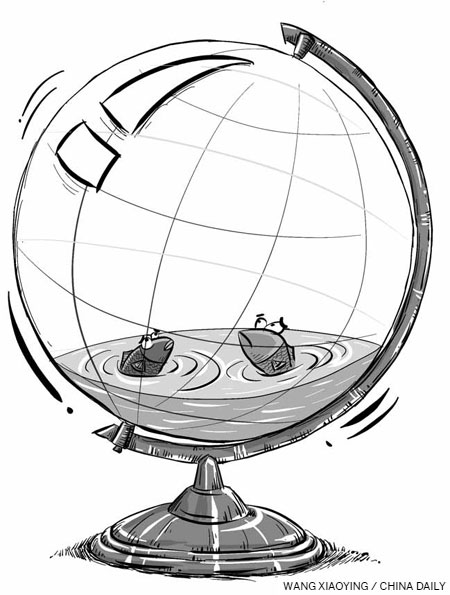
Millions of the world's poorest people face serious water-related challenges - from lack of access and shortages to disputes over supplies - with profound implications for security, economic development and environmental sustainability. As world leaders design a development agenda to succeed the Millennium Development Goals, which expire in 2015, addressing these issues should be a top priority.
Consider this: Almost 1 billion people worldwide lack access to safe drinking water, and 2.5 billion people lack adequate sanitation. The costs are staggering: thousands of child deaths every day and annual economic losses estimated at $260 billion - more than double the total of official development assistance.
Making matters worse, climate change will render water supplies more unpredictable, with increasingly frequent and intense floods and droughts imposing significant human and economic costs and impeding development in poor countries. And the expanding global population - set to reach more than 9.5 billion by 2050 - will strain water resources still further.
Urgent action is needed to ensure access to safe, affordable water and sanitation for all. First, drastic improvements in water-related services - including supply and sanitation, irrigation and drainage, energy and environmental facilities - are needed to improve health outcomes and enable more people to escape poverty.
Governments should take the lead in ensuring careful management and sustainable use of scarce water resources. Water-intensive food and energy production - among others - are dependent on uninterrupted supplies. To set clear targets for managing water scarcity, reliable, timely data are needed to understand variations in the quality and quantity of water caused by climate change and environmental degradation, as well as to identify patterns of water consumption by households, farmers and industry.
Addressing these water-related challenges requires heightened efforts in four areas. For starters, new and emerging technologies can be leveraged to design more cost-effective solutions at scale. Today, there are more Internet-connected mobile devices than human beings, providing an extensive network to create and deliver mobile-based solutions.
For example, public officials can use mobile applications to tag and respond to citizens' complaints about the supply of water and sanitation services, thereby enhancing transparency and accountability. In Liberia, data collectors on motorbikes have used mobile phones to map 10,000 previously unknown water points - an initiative that informed the country's first water investment plan, launched last year.
 New type of urbanization is in the details

Copyright 1995 - . All rights reserved. The content (including but not limited to text, photo, multimedia information, etc) published in this site belongs to China Daily Information Co (CDIC). Without written authorization from CDIC, such content shall not be republished or used in any form. Note: Browsers with 1024*768 or higher resolution are suggested for this site.
License for publishing multimedia online 0108263 Registration Number: 130349