The Tibetan translation of Tripitaka, the core scripture of Buddhism, is well known for its accuracy. The wide-ranging Tibetan translation preserves even the large volume of Indian tantric scripture that has been lost and those not contained in Chinese and Pali translations. The Tibetan translation also has other Buddhist and medical records and precious accounts on astronomy and craftsmanship.
Thanks to the support of the Chinese central government, the Tibetan translation of Tripitaka has become the largest, and most systematic and authoritative publication. The new version of the Tibetan Tripitaka includes Kangyur and Tengyur, which runs into 4,842 volumes.
Contemporary Tibetan Buddhist art with its unique tradition and distinct characteristics has become the main channel of spreading Buddhist doctrines and Tibetan culture.
A majority of the more than 3,500 monasteries in Tibetan-inhabited areas of the country have been rebuilt or were established after the founding of People's Republic of China in 1949 and showcase the architectural and artistic achievements of Tibetan Buddhism. For example, the bronze statue of Jampa Buddha at Papung Monastery in Dege, Sichuan province, is the tallest Jampa Buddha statue in the Kangba area, and the statue of Sakyamuni, the founder of Buddhism, at Litang Monastery in Ganzi, Sichuan, is the largest indoor bronze statue of Sakyamuni in the world. Besides, Tibetan butter sculptures are famous for their craftsmanship and finesse across the world.
Tibetan Buddhism also has several painting and thangka schools, with the Mantang, Chentse and Kardri schools being the three major ones. The State Council, the country's Cabinet, included the styles of the three schools in the first list of national intangible cultural heritage.
The unique music traditions of Tibetan Buddhism, too, have developed and spread far and wide. Jonang Sanskri, as one of the oldest extant musical styles, was included in the third list of national intangible cultural heritage as a living fossil of Chinese music.
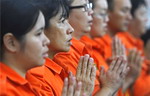
The large number of monasteries and monks and nuns, the diversity of their religious activities and the rich Buddhist scripture, and art and music schools prove that, contrary to the claims of some Westerners, Tibetans enjoy total right to religion.
The author is a researcher at the China Tibetology Research Center.
 New type of urbanization is in the details

Copyright 1995 - . All rights reserved. The content (including but not limited to text, photo, multimedia information, etc) published in this site belongs to China Daily Information Co (CDIC). Without written authorization from CDIC, such content shall not be republished or used in any form. Note: Browsers with 1024*768 or higher resolution are suggested for this site.
License for publishing multimedia online 0108263 Registration Number: 130349