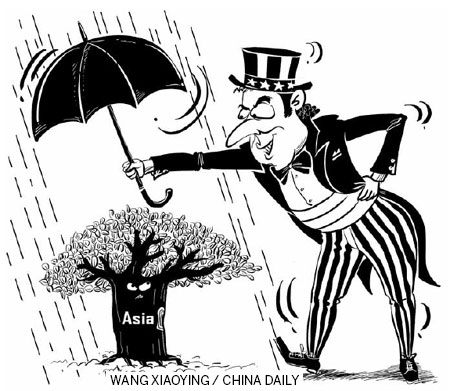
In the minds of former US government officials and policy academics who populate Washington think tanks like the Brookings Institution and the Center for Strategic and International Studies, Asia before the arrival of the East India Company's taipans and Commodore Perry's "Black Ships" was devoid of an accepted, or acceptable, international order. China, Korea, Japan and the rest of the region were backward and incapable of sophisticated engagement with each other, or with the outside world.
Only the West, especially, after World War II (a cataclysm proving the region's incapacity for harmonious peaceful co-existence), the United States, that has provided the region a loadstone capable of ordering, uplifting and pacifying its fractious, benighted nationalities.
History has bestowed upon the US a civilizing mission, informed by a variant of Sun Yat-sen's notion of "political tutelage", to recreate Asian civil societies in liberal Western modes, while US military power must be permanently imbedded in the region to suppress latent Asian barbarism.
To these think tank "scholars" (often, if not always, once-and-future US government officials/government contractors/consultants/lobbyists in Washington's revolving door quasi-public/quasi-private milieu) nothing in the past 60 years has altered the justification for this US mission or its "hard power" military forces, bases and alliance structure: not the end of the Cold War, not vibrant political processes in almost all countries, not the epochal emergence of middle classes following spectacular growth and regional and global economic integration, not the formation of intra-Asian political-economic associations.
On the contrary, the exigency of pursuing the US' civilizing and pacifying missions seems to have intensified. Indeed, it has become a vital US interest against which the lion's share of US military and government resources must be directed. Some Barack Obama administration officials will dispute it, but such thinking is behind Washington's "rebalance" (more vividly described as "pivot") to Asia.
That vested US institutional interests, particularly Pentagon's, are on high alert to prevent any slackening or backsliding in the "rebalance" program is evident in the "Return to the Rebalance" mock "Memorandum to President Obama" posted on Jan 23 on the Brookings Institution website by Jeffrey A. Bader and Jonathan D. Pollack. Bader was one of my State Department entering foreign service officer classmates in 1975, and we worked together briefly in Hong Kong. After serving in Beijing and Tokyo, I left the State Department for Citibank but Bader stayed and rose to senior policy positions directly relating to China, and was one of former secretary of state Hillary Clinton's chief China policy advisors.
 New type of urbanization is in the details

Copyright 1995 - . All rights reserved. The content (including but not limited to text, photo, multimedia information, etc) published in this site belongs to China Daily Information Co (CDIC). Without written authorization from CDIC, such content shall not be republished or used in any form. Note: Browsers with 1024*768 or higher resolution are suggested for this site.
License for publishing multimedia online 0108263 Registration Number: 130349