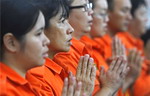
The accusation made by the Dalai Lama clique that the Chinese national flag is forced to fly over Tibet's territory goes against facts and needs to be refuted. As a national symbol, it is natural for China's national flag to fly over its own territory. As an ethnic group that loves its own motherland, it is very common for some Tibetans to hang the Chinese national flag beside their homes during major festivals. At the same time, there have never been any Tibetans detained or punished by the authorities because they did not do the same. However, the Chinese government is entitled to mete out deserved punishments to those who intentionally damage, burn and insult the national flag in accordance with the country's National Flag Law no matter who the perpetrators are or whatever ethnicities they are from. This is a universally recognized practice across the world.
As a sovereign territory of China, Tibet has never had its own "national flag" as the Dalai Lama has claimed. The Dalai Lama clique regards the "snow lion flag" as the "national flag" of an "independent Tibetan state" and thus the flag is an emblem of his separatist moves. Hanging it across Tibet's territory is a separatist gesture and should be banned by the authorities.
The self-immolations that have taken place in some Tibetan-inhabited areas in recent years do not mean "the whole of Tibet is burning" as the Dalai Lama clique claims. In fact, these self-immolations have mainly happened in limited areas where the Sichuan, Gansu and Qinghai provinces meet, especially in the Kirti Monastery in Sichuan's Aba Tibetan-Qiang autonomous prefecture. Kirti Rinpoche, the monastery's head lama, who fled Tibet with the Dalai Lama after the failed 1959 rebellion, said in March 2013 that these self-immolations are a dedication to the well-being and interests of Tibetan people and thus do not constitute a violation of Buddhist doctrines at all. He has also argued that the invisible power of Tibetans comes from such self-immolations. His words reveal the real cause of these violent acts in recent years.
All Chinese people, including Tibetans, oppose the self-immolations and such acts have drawn harsh criticism from the international community. The clique of the 14th Dalai Lama cannot continue with its dissembling after its ulterior purpose has been laid bare. The facts prove that, by plotting such self-immolations among innocent Tibetans, the Dalai Lama and his clique are attempting to force the Chinese government into political concessions and even ignite a reenactment of the "Arab Spring" in Tibet.
In an interview with the BBC on Nov 18, 2011, the 14th Dalai Lama said that why some Tibetans have committed suicide by self-immolation is because they know Western countries are supportive of an "Arab Spring" style uprising in Tibet sparked by a self-immolation. But at the same time, he complained of the "soft tone" Western countries adopt for dialogue with China. Lobsang Sangay, a leading figure in Dalai Lama clique, also expressed disappointment that "self-immolations by some Tibetans have not received the same world attention as the similar suicide of a Tunisian man that sparked the Arab Spring".
The 14th Dalai Lama has tried to make use of his religious influence and offers spiritual support to innocent young Tibetans contemplating self-immolation. In an interview with NBC on Oct 8, 2012, he said that "these self-immolators have chosen to sacrifice their lives with a sincere motive and they did this for the sake of Buddhist doctrines and human beings". In a statement issued on Nov 7 of the same year, the parliament of the so-called "Tibetan government in exile" said "self-immolation is a peaceful and non-violent action in the highest realm". But if that's the case, it is strange that all the self-immolators are young and poor and why no older and wealthy lama has done the same.
 New type of urbanization is in the details

Copyright 1995 - . All rights reserved. The content (including but not limited to text, photo, multimedia information, etc) published in this site belongs to China Daily Information Co (CDIC). Without written authorization from CDIC, such content shall not be republished or used in any form. Note: Browsers with 1024*768 or higher resolution are suggested for this site.
License for publishing multimedia online 0108263 Registration Number: 130349