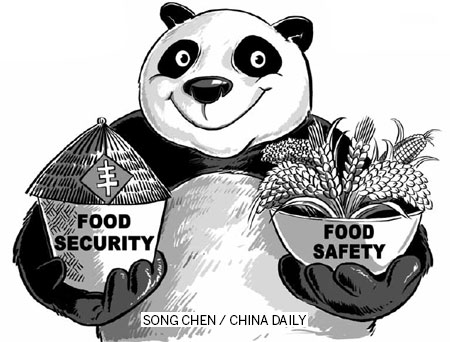
China's food security is being challenged by a mix of factors, including rising demand, rapid urbanization, scarce natural resources and agricultural labor, and greater risk of food safety and environmental problems. To address food security concerns, China had resolved to meet the bulk of its grain demand domestically. But this policy is now being revisited, suggesting a considerable increase in the already rising food imports. The No 1 Central Document released on Sunday reiterated the importance of improving the food security system while ensuring food safety.
Though it deserves the highest priority, food security does not equal grain self-sufficiency. In addition to growing challenges, China remains home to the second largest population of undernourished people in the world (160 million or about 11 percent of the country's population). Besides, a large number of people in China suffer from lack of micronutrients in their diet, the so-called hidden hunger. Striking an efficient balance between grain self-sufficiency and food security is thus important to get on the road to food security.
The No 1 Central Document says the extent of China's grain sufficiency will be somewhat relaxed and the import structure optimized. This is a welcome move. Such a policy will allow China to make better use of the international market vis-a-vis the advantages of the country's agriculture sector. It will also facilitate improved allocation of resources among different commodities. Self-sufficiency targeted to specific food grains such as rice and wheat in which China has an advantage, can protect domestic consumers from volatile international grain markets and thus promote social stability.
Conversely, China can help the regional and global markets. Stable domestic grain supply can help China reduce volatility in the global markets, because the country accounts for a large share of rice and wheat production and consumption and any swing in its imports/exports will have a significant impact on global rice and wheat prices.
But the relaxation in the policy of complete grain self-sufficiency has to be gradual. To maintain the stability of markets, food trade policies need to be consistent over time and distortion in trade policies, which undermine both national and global food security, should be avoided. Trade barriers, such as import restrictions and import tariffs, are harmful to China's poor consumers because they make food more expensive for them and close the country's market to relatively poor farmers in exporting countries. Similarly, export bans or export taxes can cause harm to farmers as they would lose opportunities of accessing higher prices in international markets.
 New type of urbanization is in the details

Copyright 1995 - . All rights reserved. The content (including but not limited to text, photo, multimedia information, etc) published in this site belongs to China Daily Information Co (CDIC). Without written authorization from CDIC, such content shall not be republished or used in any form. Note: Browsers with 1024*768 or higher resolution are suggested for this site.
License for publishing multimedia online 0108263 Registration Number: 130349