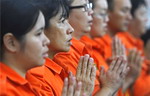
Reforms have given people greater scope to exercise their right to know about, participate in and supervise government matters
Standing at a new historical starting point in 2013, China made great achievements in the cause of building socialist democracy. It has also entered a new phase of comprehensively deepening reforms.
Democratic election is the most important aspect of socialist democracy. At the annual session of the 12th National People's Congress in the spring of 2013, its nearly 3,000 delegates elected China's new leadership, enabling a smooth transition of State power.
What is also noteworthy is the institutional innovation in the election of deputies to people's congresses in this year's elections. For the first time in more than 60 years, deputies both for rural and urban areas were elected to represent an equal number of people. Plus, more workers and farmers have been elected deputies to the 12th NPC, while fewer government and Party officials could garner support for their candidacy.
According to NPC statistics, since early 2011 the country's 2,878 county-level legislative bodies and 33,281 township legislatures have elected their deputies. More than 981 million people registered to vote in the county-level elections, while 723 million did so for the township-level elections. And more than 90 percent of the registered voters cast their ballots.
The Communist Party of China has always upheld people's democracy, because it is the soul of socialism. In 2013, the people's congress system - the fundamental political system that makes people the masters of the country- saw innovation in both theory and practice. The system now guarantees more extensive and sound representation of the population, regions and ethnic groups in the NPC.
Deliberative democracy is a unique feature of people's democracy. The Decision on Major Issues Concerning Comprehensively Deepening Reforms, issued by the Third Plenary Session of the 18th CPC Central Committee in November, was drafted after taking into consideration the suggestions of public figures outside the Party. At the beginning of 2013, the Chinese People's Political Consultative Conference conducted a field research focusing on 10 major issues. And in September, CPC General Secretary Xi Jinping hosted a symposium to hear the proposals and suggestions of non-Party members.
The introduction of political consultation into the decision-making process reflects the country's endeavor to perfect the socialist deliberative democracy system. Holding extensive consultations over political, economic, cultural and social issues makes it more convenient to reflect on social problems and solicit people's opinions in order to reach a consensus and enhance cohesion.
 New type of urbanization is in the details

Copyright 1995 - . All rights reserved. The content (including but not limited to text, photo, multimedia information, etc) published in this site belongs to China Daily Information Co (CDIC). Without written authorization from CDIC, such content shall not be republished or used in any form. Note: Browsers with 1024*768 or higher resolution are suggested for this site.
License for publishing multimedia online 0108263 Registration Number: 130349