Editor's note: President Xi Jinping delivered a speech at a symposium commemorating the 120th birth anniversary of Chairman Mao Zedong on Dec 26. Following on this page are excerpts from the speech:
National liberation and socialism with Chinese characteristics
Comrade Mao Zedong was a great patriot and national hero of the modern times, the core of the first generation of Chinese leadership and a great figure who changed the face of the nation and led Chinese people to a new destiny. He was a great Marxist, a great proletarian revolutionary, strategist and theoretician, and a pioneer of the application of Marxism in China.
When he was young, Mao set for himself the goal of lifting the Chinese nation out of crisis. After making repeated comparisons of the ideologies and paths at that time, Mao made a resolute decision of choosing Marxism-Leninism to revive China. Mao consistently adhered to such a pursuit in his revolutionary career despite the enormous changes of the times and the arduous setbacks he suffered.
In search of truth and revolutionary victory
The founding of the Communist Party of China in 1921 created for the Chinese people the backbone for advancement. However, China faced the special national condition of peasants being the overwhelming majority of the population in what was then a semi-colonial and semi-feudal society. The backward and scattered small-scale peasant economy, its ingrained social influences and the sufferings brought upon China by the invasions and exploitation of Western powers presented to the Chinese people a serious question: What kind of path could lead the Chinese revolution to victory?
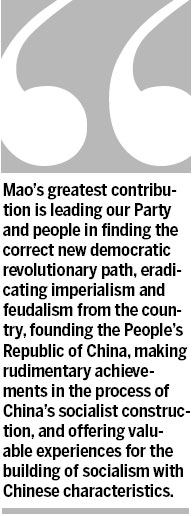
Mao creatively resolved a series of major issues on how to combine the basic principles of Marxism-Leninism with China's actual conditions, and made profound analyses of China's social formation and class status. Through relentless explorations, Mao became fully aware of the essence, target, task and forces of China's revolution, put forward a two-step strategy - from new democratic revolution to socialism - adopted the general new democratic revolutionary line, and opened the revolutionary path of "surrounding cities with the countryside" and finally achieved a nationwide victory.
Mao creatively built the CPC into a party armed with scientific theories and revolutionary spirit and with the "blood and flesh ties" of the people. He spearheaded the building of a new people's army. Mao creatively solved a series of significant problems facing the building of a revolutionary front that could unite the majority of the Chinese people and won over a broad allied force for the cause of the Party and the people. He led us to creatively put forward and implement a series of correct strategies and tactics and resolved one after another complicated and difficult issues in a timely manner in the process of the Chinese revolution.
After 28 years of tenacious and bloody fighting and struggle, the Party and the Chinese people defeated the Japanese imperialist invaders and overthrew the rule of imperialism, feudalism and bureaucratic capitalism to achieve a new democratic revolutionary victory and realize national independence and people's liberation which generations of Chinese had dreamt of.
Building China into a nation of strength and prosperity
The founding of the People's Republic of China made the Chinese people the masters of their nation, society and destiny, and was a giant step toward the establishment of people's democracy. It also realized China's reunification and national unity and ended the semi-colonial and semi-feudal history of old China.
After the founding of New China, the first-generation Party leadership, with Mao at the core, led the Chinese people to overcome the war-induced trauma, restored the collapsed national economy and put forward a general line for the transitional period, creatively realizing a transition from new democratic to socialist revolution and enabling the nation with one-fourth of the world's population to transform into a socialist society, the profoundest and greatest social vicissitude in China's history. The victory of the new democratic revolution was the fundamental political precondition and systematic foundation for the establishment of China's socialist system and all its development and progress in contemporary times.
After the establishment of the socialist system, the greatest question was: How should the Party proceed with socialist construction? In the following years, Mao minutely explored the paths for socialist construction that suited China's national conditions. Within a not too long period, Chinese society witnessed earth-shaking changes, with the building of a relatively independent and complete industrial and economic system and the making of the "two bombs and one satellite (atomic and hydrogen bombs and artificial satellite)" indigenously. That helped the country gather important experiences on how to carry out socialist construction in a country with an extremely backward production system.
 New type of urbanization is in the details

Copyright 1995 - . All rights reserved. The content (including but not limited to text, photo, multimedia information, etc) published in this site belongs to China Daily Information Co (CDIC). Without written authorization from CDIC, such content shall not be republished or used in any form. Note: Browsers with 1024*768 or higher resolution are suggested for this site.
License for publishing multimedia online 0108263 Registration Number: 130349