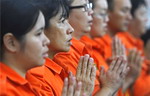
World dialogue on the Chinese Dream
Robert Lawrence Kuhn, an international corporate strategist and investment banker.
I have five high-level categories with which to describe and analyze the Chinese Dream: national, personal, historical, global, antithetical.
The national Chinese Dream was defined famously by President Xi Jinping as "the great rejuvenation of the Chinese People". It is the collective vision of the Chinese nation, with the material goal of China becoming a "moderately well-off (xiaokang) society" by about 2020 and a fully developed nation by about 2050.
The personal Chinese Dream focuses on the well-being of individual Chinese citizens and thus modifies traditional notions of the primacy of the collective over the individual. To fulfill properly the national Chinese Dream is to fulfill properly the personal Chinese Dream. The personal Chinese Dream refutes the foreign stereotype that China sacrifices individuals to serve the purposes of the collective.
The historical Chinese Dream recognizes that China's rich millennia-long civilization with its high culture and seminal achievements, aspiration and expectation, turmoil and trauma, challenge and triumph, and China's more recent development of its political theory. A unified, stable, sovereign and peaceful China has long been the goal of the Chinese people and of Chinese leaders.
The global Chinese Dream can be described as how the world benefits from the Chinese Dream and why the world worries about the Chinese Dream. That the entire world derives material advantages from the Chinese Dream is apparent in the globalized economy. The higher the standard of living of the Chinese people, the greater their domestic consumption, which means that more products are imported, creating jobs and prosperity with a multiplier effect worldwide.
Furthermore, as China advances in science and technology, the more the world can share in the benefits of China's success by getting needed products at affordable prices.
The antithetical Chinese Dream takes a different perspective, focusing on the tensions or contradictions among the various kinds of Chinese Dreams. These are the normal tradeoffs that all societies must continuously consider.
There are several natural tensions implicit in the Chinese Dream: economic development versus environmental damage; economic development versus social imbalances (i.e. it is usually more efficient to invest in developed areas, but that would make social imbalances worse); national versus personal (investment tradeoffs between national projects such as basic science research, the space program, defense needs, and the like, and the immediate needs of the people, such as healthcare); national versus global (balancing China's vital sovereignty over disputed borders or maritime territories with the concerns of neighbors, and protecting the national without disturbing the global); long-term versus short-term (investment tradeoffs between long-term projects such as the South-to-North Water Diversion Project and the many short-term needs such as subsidies for poor or rural citizens).
By rejuvenating China, the Chinese Dream will benefit the entire world.
 New type of urbanization is in the details

Copyright 1995 - . All rights reserved. The content (including but not limited to text, photo, multimedia information, etc) published in this site belongs to China Daily Information Co (CDIC). Without written authorization from CDIC, such content shall not be republished or used in any form. Note: Browsers with 1024*768 or higher resolution are suggested for this site.
License for publishing multimedia online 0108263 Registration Number: 130349