In advance of today's EU-China summit in Beijing, European leaders possibly have been studying the reform package agreed at the Third Plenum last week. Following initial disappointment at the rather vague communiqu, the details published in recent days have been more positive and have set the stage for a successful meeting.
The major reform package announced at the Third Plenum of the 18th Communist Party of China Central Committee will not only change the lives of Chinese people but also impact relations between China and the European Union in many ways. Among the reforms that will have a direct impact on relations between the two sides is the much-cited commitment to give the market a "decisive" role in the economy. Together with some of the other reforms - such as the pledge to better protect intellectual property rights and to decrease the number and size of State-owned enterprises - it would bring the Chinese economy closer to fulfilling the criteria of a market economy. The EU's refusal to grant market economy status to China has strained relations in recent years. Now it looks like a solution is in sight. At the very latest, China will receive market economy status in 2016.
 |
|
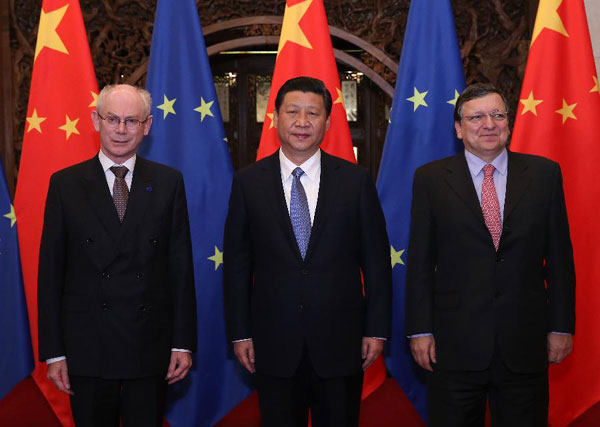
Chinese President Xi Jinping (C) meets with European Council President Herman Van Rompuy (L) and European Commission President Jose Manuel Barroso, who are here for the 16th China-EU Summit, in Beijing, capital of China, Nov 20, 2013. [Photo/Xinhua] |
Equally important for EU-China relations are two-way investments. China's new leadership have emphasized the need to further stimulate Chinese investment abroad and foreign investment in China. The reforms will create a more stable environment for investors in China. Today's summit will launch negotiations for an investment agreement between the China and the EU which should provide for greater protection of investment and market access. China's share of foreign direct investment in Europe accounted only for 2.2 percent in 2012 while the EU accounted for 20 percent of the FDI in China.
Proposed political and social reforms will also impact relations. The EU has been critical of the strict family planning policy under which most families are allowed to have only one child and the reeducational labor camps. With both due to be abolished this should improve relations. The EU will continue to push for a rule of law dialogue. The Plenum resolution stresses the perfection of "mechanisms to guarantee lawyers' professional rights", and the need to "perfect structures for the judicial protection of human rights". This is music to European ears - but much will depend on the interpretation and implementation of the new procedures. Successful human rights reforms will eventually improve the prospects of the EU reconsidering its arms embargo. However, this is not likely to happen in the near future.
Other important areas of Sino-EU cooperation impacted by the reforms are the flagship initiatives on urbanization and green growth.
The Chinese announcement to "optimize urban space structuring" and to continue to make cities more liveable and green offers further opportunities for cooperation. The expansion of eco-cities such as in Tianjin to other Chinese cities would create numerous opportunities for the EU and European businesses. There will be a parallel meeting on the urbanization partnership attended by Siam Kallas, the European commissioner for transport.
A commendable initiative is the plan to "establish lifelong ecological and environmental harm responsibility investigation systems". Along with the cancellation of regional GDP assessment in environmentally weak regions it creates accountability of officials and incentives for environmentally friendly development, which could open up further business and cooperation opportunities for the EU.
The same is the case with the envisioned development of carbon emission rights and water rights trading schemes where the EU has some experience to share.
But here again the details remain unclear. Even though the report mentions independent environmental supervision, it does not specify who will supervise and how independence will be ensured. In the areas of food security and developing the Chinese social security system the EU and China could further expand already existing initiatives.
Exchange under the people-to-people dialogue is likely to be further increased as the resolution stresses the need to "raise cultural openness level" and to "broaden foreign cultural exchange".
The reform plan thus creates a mixed picture -while many of the planned reforms show great potential, it all depends on their interpretation and implementation. The success of the Plenum's reform package would be welcomed by the EU. However, the emphasis on the Party's "leading core function in all areas" shows the political reform as West expects is not on the agenda.
In the short term it would seem that the planned economic reforms will offer considerable opportunities to deepen EU-China relations. Improving the protection of intellectual property and a deal on investment protection will reduce frictions on both sides. The Plenum has approved an ambitious reform package. It is now up to the Chinese government to strive to implement the reforms.
The author is a research fellow at EU-Asia Centre in Brussels.
 New type of urbanization is in the details

Copyright 1995 - . All rights reserved. The content (including but not limited to text, photo, multimedia information, etc) published in this site belongs to China Daily Information Co (CDIC). Without written authorization from CDIC, such content shall not be republished or used in any form. Note: Browsers with 1024*768 or higher resolution are suggested for this site.
License for publishing multimedia online 0108263 Registration Number: 130349