On the eve of World Day for Prevention of Abuse and Violence Against Children, the world's media - including the media in China - are increasingly bringing to light incidences of violence against children. It's often hard to absorb the details of these deeply upsetting stories, but when you do, one of the consistent elements is that most violence occurs within or near the family, committed by people known and trusted by the child.
Violence against children is often invisible, and it takes several different forms, but its consequences usually last a lifetime. The World Health Organization's established definition encompasses: physical violence, such as spanking or beating; psychological violence, including degrading or intimidating the child; sexual violence, including any kind of sexual interaction between an adult and a child; neglect, including failure to provide adequate food and shelter.
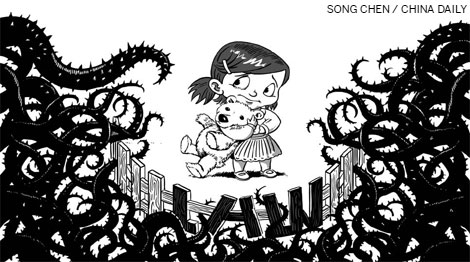
Because the human brain is growing and changing from conception up to the mid-20s, violence against children in early years and in adolescence, even beyond, has a major impact on brain development. According to an article in The Lancet in January, 2009, global evidence demonstrates violence against children substantially contributes to child mortality and morbidity and has immediate and life-long effects on physical and mental health, school retention, academic achievement, risky sexual behavior, obesity, drug and alcohol misuse and criminal behavior, both during childhood and continuing through adulthood. Due to its high prevalence in many parts of the world, violence against children has been increasingly characterized as a global health epidemic, one that requires the same kind of public investment given to other serious public-health concerns with lifelong consequences. It is therefore highly commendable that China has committed to include violence against children as one of the definitions in planned family violence legislation.
Evidence on both the causes of violence against children and the effectiveness of public response is still emerging. But analysis of global practices strongly suggests that prevention through effective family welfare systems is more cost effective than dealing with the consequences of violence against children. Some of the most effective interventions are simple and relatively low in cost: parenthood training, home visits by medical and social work professionals and education in life skills for children and adolescents.
To date China's most important piece of legislation to address violence against children is the 2006 Law on the Protection of Minors, which prohibits violence against children in the family. This law however has a number of critical weaknesses: It does not contain a comprehensive definition of violence against children, and lacks important legal provisions that ensure protection of victims and prosecution of offenders.
China's long-anticipated draft Family Violence Law represents a significant opportunity to define violence against children and integrate many of the currently missing key provisions on child protection into China's legal framework. These include legal provisions such as protection orders for victims, mandatory reporting for all professionals having direct contact with children, legal representation for children in cases of family violence and the state guardianship system.
United Nations agencies working on family violence issues in China commend increased recognition for the importance of developing national legislation on family violence that is inclusive of women, the elderly, children and the disabled. We look forward to supporting government, civil society, and other partners in China in finalizing the law drafting process to help ensure the right to a life free from violence for all.
The author is United Nations Children's Fund's representative in China.
(China Daily 11/19/2013 page9)
 New type of urbanization is in the details

Copyright 1995 - . All rights reserved. The content (including but not limited to text, photo, multimedia information, etc) published in this site belongs to China Daily Information Co (CDIC). Without written authorization from CDIC, such content shall not be republished or used in any form. Note: Browsers with 1024*768 or higher resolution are suggested for this site.
License for publishing multimedia online 0108263 Registration Number: 130349