One of the most important developments in recent times in China has been the announcement of a change in the State Council's management of the economy and the society, which is widely expected to be the main focus of the upcoming Third Plenum of the 18th Communist Party of China Central Committee.
Likening decentralization and supervision to the wheels of a car, Premier Li Keqiang has argued that only with both decentralization and supervision can the car run smoothly. Li has also spoken about a more nuanced coordination between the government, market and society to engineer a new phase in the evolution of the socialist market economy.
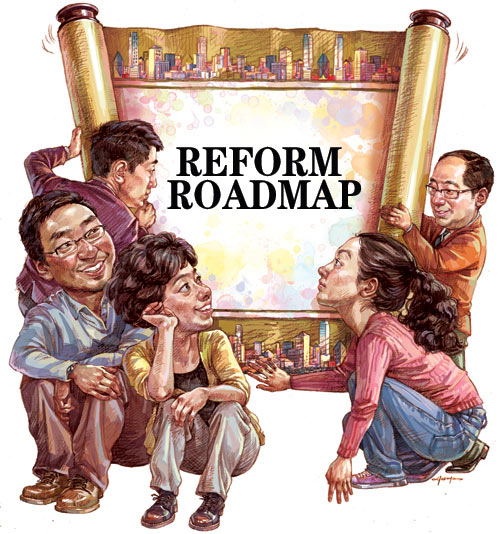
But what is different about the latest round of decentralization measures? How will these measures be implemented to unleash fresh energy to the market? How will they impact on the relationship between the central and local governments? Will they have any significant effect on domestic and foreign investment in China? What should one make of Li's assertion that these measures are irreversible and only beginning of curtailing the powers of the State Council?
Ever since China embarked on reform and opening-up, it has seen various rounds of decentralization, centralization and recentralization motivated by economic and political factors.
The first major decentralization was widely known as "eating in separate kitchens", because it aimed to boost production by giving some provinces more leverage to cash in on the benefits of reforms. However, the debates between the so called "conservatives" and "reformers" in the 1980s and the weakening of the Chinese "State capacity" thesis by two eminent scholars, Wang Shaoguang and Hu Angang, forced China's central leadership to introduce recentralization measures. Thereafter there have been policy changes here and there, but the 1994 recentralization policies including the tax sharing reform led to a fundamental shift in relations between the central and local governments.
Local governments from provincial to sub-provincial levels had to contend with growing expenses and a drastic reduction in their share of the central government's revenues. This forced provincial governments to resort to unsustainable, uneconomic and at times illegal and corrupt ways of raising funds to meet their development needs.
What didn't help matters were the evaluation policies for officials, which prompted the leadership at various local levels to attract the attention of their political bosses by projecting a very attractive report card dominated by progress made in terms of economic development. These problems became more pronounced once former president Hu Jintao and former premier Wen Jiabao introduced the concepts of the Scientific Outlook on Development and building a harmonious society and made the leap from economic governance to social governance. This brought into the spotlight the dangerous practices, such as land grabbing to promote economic activity and debt-financing vehicles, of cash-strapped local governments.
 New type of urbanization is in the details

Copyright 1995 - . All rights reserved. The content (including but not limited to text, photo, multimedia information, etc) published in this site belongs to China Daily Information Co (CDIC). Without written authorization from CDIC, such content shall not be republished or used in any form. Note: Browsers with 1024*768 or higher resolution are suggested for this site.
License for publishing multimedia online 0108263 Registration Number: 130349