The Information Office of the State Council has published nine white papers on Tibet, which give a comprehensive account of the region in terms of its history, politics, economy, culture and religion. The per capita disposable income of urban dwellers in Tibet in 2012 was 18,056 yuan ($2,962), an increase of 11.5 percent year-on-year, and that of Tibetan peasants and herdsmen was 5,645 yuan, up 15.1 percent year-on-year. This shows the rapid development of Tibet.
Our research on the social and economic development in Tibet shows the region has made great progress in strengthening social security, with an increasing number of Tibetans covered by social insurance. The improvement in people's livelihood is the direct manifestation of the protection of human rights.
The 18th National Congress of the Communist Party of China, held in November last year, proposed creation of equal opportunities in rural and urban areas, because China is still a developing country where a large number of people depend on agriculture. Tibet is part of this plan, because peasants and herdsmen account for 80 percent of its total population.
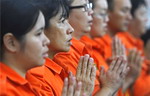
Tibet is home to more than 1,780 Buddhist temples and monasteries and nearly 50,000 monks and nuns, mostly coming from peasants' and herdsmen's families. As a result, some elderly people are left with no family members to look after them and are forced to live in monasteries for the rest of their lives. In the past, the monasteries had to bear the cost of eldercare, but a new policy implemented by the Tibet autonomous region in November 2011 offers pension and medical insurance to monks and nuns in all monasteries and nunneries. This has not only eased the financial burden of the monasteries, but also hugely benefited the elderly people.
Last year, 21 monks above the age of 60 received their basic pension at the inauguration ceremony for pension distribution at Ganden Monastery in Lhasa, capital of the autonomous region. On the occasion, a 65-year-old monk said his dream had finally come true and thanked the government for making the rest of his life stress-free.
Most of the nunneries in Tibet are in remote places and thus receive little donation and financial subscription. But the central and local governments are now taking care of most of the medical needs of the people there. A deputy director of Canggu Nunnery's management committee says that after hearing about the preferential policies, an increasing number of nuns are buying pension and medical insurance.
Last year, I visited a nunnery in a high-altitude valley near Lhasa and was impressed by the solar water heaters installed by the government's working group in the solemn and picturesque cloister. Government projects have helped improve hygiene in nunneries and villages and, as a result, women today are less susceptible to contracting gynopathy.
Besides, the government has launched a free health check-up program to the benefit of urban and rural residents, as well as monks and nuns in Tibet, which the locals have welcomed wholeheartedly.
The human rights cause is progressing well in Tibet. My observation is only on part of the progress that China has made in improving the lives of the Tibetan people.
The author is editor-in-chief of China Tibetology Publishing House, affiliated with the China Tibetology Research Center.
(China Daily 10/19/2013 page5)
 New type of urbanization is in the details

Copyright 1995 - . All rights reserved. The content (including but not limited to text, photo, multimedia information, etc) published in this site belongs to China Daily Information Co (CDIC). Without written authorization from CDIC, such content shall not be republished or used in any form. Note: Browsers with 1024*768 or higher resolution are suggested for this site.
License for publishing multimedia online 0108263 Registration Number: 130349