Like most Chinese people do in the first week of October, I spent my first National Day holiday eight years ago traveling to Xi'an. The ancient capital of China ranks as one of the best tourism destinations in the country. But since I went on a group tour, that visit was largely a bust.
The trip was organized by the university where I taught English during my first year in China for its foreign teachers, and naturally we were all keen to see the terra cotta warriors. However, we spent the entire morning on the day we were scheduled to visit the warriors at the misleadingly named terra cotta restoration center. That place was really an obligatory shopping stop aimed at making us spend money on overpriced merchandise. Needless to say, no one felt like parting with his money despite the coaxing of the staff.
Chinese tourists going on bargained-down priced group tours are not so lucky. Such package tours typically offset the low margins or losses incurred by the travel agencies because of low pricing by forcing tourists to buy goods at designated shops - the agencies get commissions for such purchases - tip tour guides, or pay extra for surprise add-on stops.
One tour guide even attacked a tourist for not spending enough at places from he was to get kickbacks on sold items.
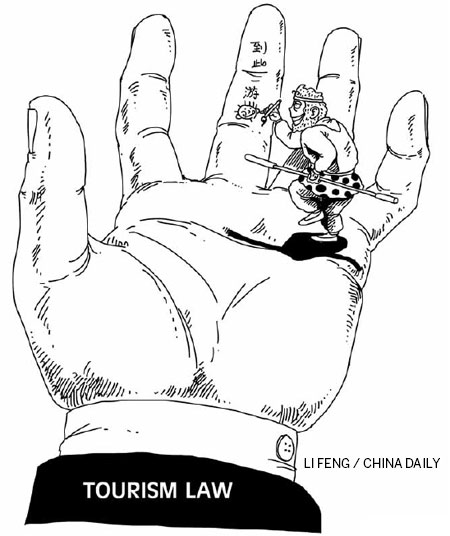
These problems, along with the bad accommodation and meals offered by low-priced tour operators, have prompted the government to enact a new law that goes into effect from Oct 1. The new law subjects operators who cheat tourists through hidden charges, such as coerced shopping, unexpected itinerary changes, and extra charges for tips, to fines and possible cancellation of their business licenses.
This much-needed move to empower consumers will surely be welcomed by almost everyone in China. Indeed, when I asked my Chinese colleagues about it, they were quite happy with the law, while complaining bitterly about their experiences with package tours.
The tourism law, which applies to both domestic and outbound tours, could prompt travel agencies to increase prices by 20 to 30 percent. But the increase will be offset by the elimination of hidden charges - under the new legislation, prior consent of tourists is mandatory for shopping stops or itinerary changes.
But some potential tourists might be put off by the expected increase in package tour prices. Many may already have signed up for such trips thinking they were getting a good deal. And while they should have known better, one can hardly blame ordinary people, who are keen to see China and the world, for wanting to travel on the cheap.
These people have to save lots of money for housing, children's education and unexpected health emergencies, leaving them with limited funds for travel. China has made considerable progress in addressing some of these problems - for example, 90 percent of the people now have some form of health insurance. However, as the country's new leaders recognize, much still needs to be done to boost consumer spending in China.
Tourists opt for package tours not just to save money, but also because such trips cram in lots of destinations in a short period of time. Again, although it would be better for travelers to spend more time at one place to really get to know it, ordinary Chinese have good reason for doing the opposite. Most get very few days of paid leave and wish to see, or claim to have seen, more rather than fewer places. So naturally they opt for tours with crowded itineraries.
The new tourism law also aims to curb the increase in entry fees at scenic and historic sites. This provision will deal with moves like the recent introduction of a 148-yuan ($24.2) entry fee for Fenghuang old town in Hunan province.
While the new law is clearly welcome, local governments might not go along with it. For quite some time, many of them have been exploiting their natural scenic and historic sites as profit-making tools, as opposed to national treasures that should be accessible to and enjoyed by all Chinese.
Moreover, in many of China's poorer regions, tourism has an outsized impact on the local economies. In Yunnan province, for example, tourism accounts for 7 percent of the GDP. Local authorities may balk at not just preventing the entry fees for tourist sites from rising, but also the changes in tour packages, especially if the latter causes a drop in number of tourists.
The new tourism law, then, is a good first step. But a lot of heavy lifting remains to be done to place China's tourism industry on a sound footing and to boost domestic travel.
The author is an American corporate trainer in China.
(China Daily 09/30/2013 page9)
 New type of urbanization is in the details

Copyright 1995 - . All rights reserved. The content (including but not limited to text, photo, multimedia information, etc) published in this site belongs to China Daily Information Co (CDIC). Without written authorization from CDIC, such content shall not be republished or used in any form. Note: Browsers with 1024*768 or higher resolution are suggested for this site.
License for publishing multimedia online 0108263 Registration Number: 130349