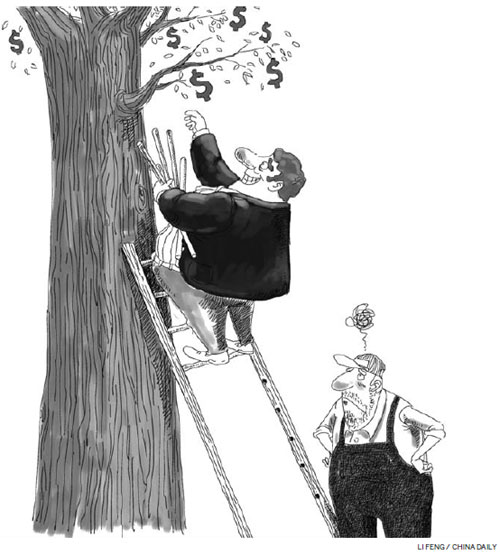
The United States has long been seen as the "land of opportunity", where people who work hard get ahead. Belief in this fundamental feature of America's national identity has persisted, even though inequality has been gradually rising for decades. In recent years, however, the trend toward extremes of income and wealth has accelerated significantly, because of demographic shifts, the economy's skills bias, and fiscal policy. Is the collapse of the American dream at hand?
From 1997 to 2007, the share of income accruing to the top 1 percent of US households increased by 13.5 percent. This is equivalent to shifting $1.1 trillion of Americans' total annual income to these families - more than the total income of the bottom 40 percent of US households.
Inequality's precise impact on individual well-being remains controversial, partly because of the complex nature of the metrics needed to gauge it accurately. But, while objective indicators do not provide a complete picture of the relationship between income inequality and human well-being, how they are interpreted sends important signals to people within and across societies.
If inequality is perceived to be the result of just reward for individual efforts, it can be a constructive signal of future opportunities. But if it is perceived to be the result of an unfair system that rewards a privileged few, inequality can undermine individuals' motivation to work hard and invest in the future.
In this sense, current US trends have been largely destructive. Economic mobility, for example, has declined in recent decades, and is now lower in many other industrialized countries as well, including Canada, Finland, Germany, Japan and New Zealand. An American worker's initial position in the income distribution is highly predictive of his or her future earnings.
Moreover, there is a strong inter-generational income correlation (about 0.5) in the US, with the children of parents who earn, say, 50 percent more than the average likely to earn 25 percent above their generation's average. Indeed, the US now lies near the middle of the World Bank's ranking of economic opportunity, well below countries like Norway, Italy, Poland and Hungary.
Some argue that, as long as the US maintains its economic dynamism, leadership in technological innovation and attractiveness to immigrants, income inequality will remain irrelevant. But other pertinent trends - such as failing public schools, crumbling infrastructure, rising crime rates and ongoing racial disparity in access to opportunities - seem to refute such claims. After all, having some of the world's top universities means little if access to them is largely a function of family income.
 New type of urbanization is in the details

Copyright 1995 - . All rights reserved. The content (including but not limited to text, photo, multimedia information, etc) published in this site belongs to China Daily Information Co (CDIC). Without written authorization from CDIC, such content shall not be republished or used in any form. Note: Browsers with 1024*768 or higher resolution are suggested for this site.
License for publishing multimedia online 0108263 Registration Number: 130349