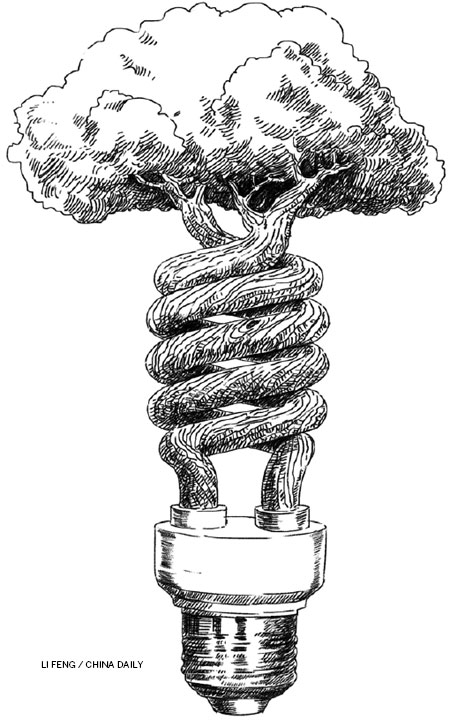
Being "thrifty" means spending one cent as if you have only half a cent. This is an old Chinese saying to warn people to handle affluence without forgetting about a potential crisis. Underlying this common sense is an ethic rooted in Chinese culture: wasting is bad.
President Xi Jinping has urged Chinese people to "build a thrifty society", because if we persist with our business-as-usual production and consumption pattern we would invite a resource and environmental crisis.
One "inconvenient truth" is that China uses about 20 percent of the total global energy to produce about 12 percent of the world GDP. The country's energy consumption per unit of GDP is 2.2 times that of the world average. A similar pattern is seen in the consumption of other resources such as steel, cement and other raw materials, as highlighted by State leaders and experts at the International Forum on Building Ecological Civilization hold in Guiyang, Guizhou province, last month. In doing so, the leaders indicated that huge amounts of energy could be saved in China by improving efficiency.
One consequence of high energy and/or resource consumption is environmental pollution. Five of the seven major river systems in China are polluted, and their water quality at 40-50 percent of the monitored points is below the level III national standards. Since early this year, people living in North China have experienced serious air pollution. And pollution, according to a Chinese Academy of Social Sciences report, shaves off up to 9 percent of China's GDP.
Natural resources are limited, so is the capacity of the environment to cope with their loss and subsequent pollution. By continuing with unchecked growth, we will deplete the resources and over-saturate the environment with pollutants. Technology could be a solution, but the development of technology can never match the pace of the current production and consumption levels.
What then is the solution? The answer is "building a thrifty society".
In a thrifty society, wealth is created both by saving and production. If we save energy, we can make do by generating less energy. The difference is that (unlike a power plant), saving energy does not require resource conversion-coal/oil and water to electricity. The energy and environmental constrains China faces make it clear which solution is the right one.
 New type of urbanization is in the details

Copyright 1995 - . All rights reserved. The content (including but not limited to text, photo, multimedia information, etc) published in this site belongs to China Daily Information Co (CDIC). Without written authorization from CDIC, such content shall not be republished or used in any form. Note: Browsers with 1024*768 or higher resolution are suggested for this site.
License for publishing multimedia online 0108263 Registration Number: 130349