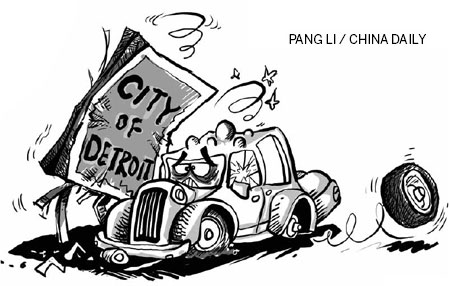
When the city of Detroit filed for bankruptcy, it became the largest such filing in United States history. Detroit's population has dropped from 1.8 million in 1950, when it was America's fifth-largest city, to less than 700,000 today. Its industrial base lies shattered.
And yet we live in a world where cities have never had it so good. More than half of the world's population is urban for the first time in history, and urban hubs generate an estimated 80 percent of global GDP. These proportions will rise even higher as emerging market economies urbanize rapidly. So, what can the world learn from Detroit's plight?
As recently as the 1990s, many experts were suggesting that technology would make cities irrelevant. It was believed that the Internet and mobile communications, then infant technologies, would make it unnecessary for people to live in crowded and expensive urban hubs. Instead, cities like New York and London have experienced sharp increases in population since 1990, after decades of decline.
One factor that has helped cities is the nature of 21st century life. Previously, life in developed countries was based on daily routines: people went to work in offices and factories, returned home to eat dinner with their families, watched their favorite television programs, went to sleep, and repeated the cycle all over again the next day.
Such regular cycles no longer apply to most peoples' lives. In the course of a work day, people mix and match many activities - they may work at a desk, but they may also meet a friend for lunch, go to the gym, do chores, travel on business, shop online and so on.
Similarly, time at home is no longer clearly demarcated, with people working online or participating in conference calls even as they manage their family life. We have discovered that this multi-tasking life is best done in cities, which concentrate a multiplicity of hard amenities - airports, shops, schools, parks, and sports facilities - as well as soft amenities like clubs, bars and restaurants.
Another factor is that cities have increased in importance as hubs for innovation and creativity. Until the 19th century, innovation was carried out mostly by generalists and tinkerers, which meant that the accumulation of new knowledge was slow, but its diffusion across different fields was rapid. In the 20th century, knowledge creation became the job of specialists, which accelerated innovation but retarded inter-disciplinary application.
 New type of urbanization is in the details

Copyright 1995 - . All rights reserved. The content (including but not limited to text, photo, multimedia information, etc) published in this site belongs to China Daily Information Co (CDIC). Without written authorization from CDIC, such content shall not be republished or used in any form. Note: Browsers with 1024*768 or higher resolution are suggested for this site.
License for publishing multimedia online 0108263 Registration Number: 130349