The US as a global risk generator
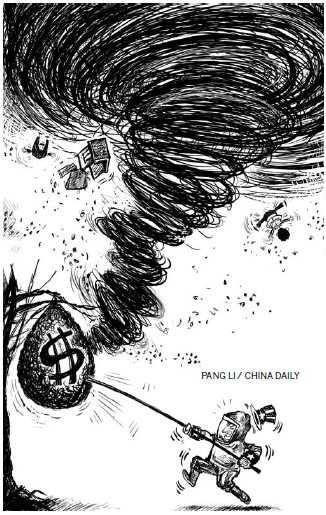
The US economy continues to have a hard time recovering from the global financial crisis. So the last thing one would expect the US government to do is to engage in policies that open the floodgates to severe risks in financial markets again. And yet it is precisely doing that.
For all the attention being paid to the Federal Reserve's "tapering", what Washington has in its crosshairs is something quite different. It is putting massive pressure on the Commodity Futures Trading Commission and the Security and Exchange Commission. Unless policymakers, and the public at large, act quickly to counter that pressure, the disastrous past - a financial industry running amok - may well be not just be the US' national but also the common global future.
How is this even possible? Even though the US Congress passed the Dodd-Frank financial reform law a few years ago as a bulwark against recurring financial crises, the legislation actually left most of the key decisions - the actual detailed rule making to rein in the financial industry - for later.
At the center of this entire issue is Gary Gensler, a former Goldman Sachs partner, who is now the Commodity Futures Trading Commission chairman. Gensler is one of the few officials who can credibly say that, having worked in the lion's den for many years, he is committed to rectifying what he knows is truly troublesome in the boiler rooms of the US financial industry.
And yet the deck is stacked against him. But this unsettling imbalance in the US political process has consequences way beyond US borders, because its financial industry is still in a dominant position globally, and sets many of the standards and practices for "what goes". Besides, the G20 and the Financial Stability Board have also pledged that powerful countries like the US would see to it that the global impact of their national rule making would be taken into account.
But now the US could blow a hole in the Dodd-Frank law that would allow many of the key global operations of US banks to be entirely exempted from regulation. In fact, the first blow came late last year. When the US Congress was on Thanksgiving holiday, the Treasury Department very quietly exempted foreign exchange swaps and forwards from the regulations.
Why should the American and global public care about this? After all, when US banks operating offshore, and in places like the Republic of Korea, sell FX derivatives to exporters, it allows them to hedge against FX risks. That sounds innocuous enough.