China and India should build cooperation around their shared interests in global governance reform in the 'Asian century'
The significance of China-India relations is strategic and its impact global because both are large developing countries and emerging markets, Premier Li Keqiang told visiting Indian External Affairs Minister Salman Khurshid in Beijing on May 10. On his return to New Delhi, Khurshid said: "India and China have to collaborate for the Asian century."
Giving shape to this vision should be on top of the agenda of the high-level dialogue between China and India during Li's two-day visit to India starting from May 19.
The re-emergence of China and India is a response to globalization. It is based on the strength of their economy, not on the size of their militaries. According to an objective analysis of long-term economic trends by the Organization for Economic Cooperation and Development, Asia will be the world's economic powerhouse around 2030 just as it was before 1800.
OECD member states now account for two-thirds of the global output, while China and India account for one-fourth. But by 2060, the two countries will account for a little less than half the global GDP with OECD states' share shrinking to one-fourth. China is expected to overtake the United States to become the world's largest economy around 2020 and India's GDP could exceed that of the US by 2060.
By 2060, the demand for food, water and energy in developing countries is expected to double. Hence, reshaping the world order that until now has served the resources and security needs of 20 percent of the global population into one that will benefit all of humanity will require a common definition of the collective future of countries.
It is thus imperative that India and China reconstruct international relations theory, because the focus of realists and idealists both is on material force and material benefit whereas what is needed is a global vision of sharing natural resources and technology.
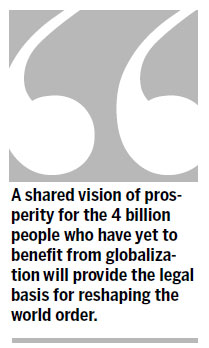
A shared vision of prosperity for the 4 billion people who have yet to benefit from globalization will provide the legal basis for reshaping the world order.
The multilateral system is now divided into three related but distinct spheres. The UN, given its stress on political and human rights, has kept out redistribution from its agenda. Economic and social issues have been relegated to the Bretton Woods Institutions with governance based on "one dollar, one vote" rather than "one country, one vote". This compartmentalized arrangement is not able to respond to tradeoffs between economic growth and the Earth's ecological limits.
The shift, therefore, will be more than just a continuation of the current system, because it will require new global rules based on the market as well as social considerations. Creating markets for economic growth and then creating new markets to clean up the environmental mess left behind by that growth are the causes of the global ecological crisis. Climate change is an example of market failure. Besides, free market ideology or "Washington Consensus" has also come under question after the global financial crisis.
In a multipolar world, sitting on the high table has lost its relevance. In the UN Security Council, the focus is shifting to preventive diplomacy and mediation - promoting peace rather than managing conflicts. In just five years, the BRICS grouping has moved beyond dialogue to cooperative mechanisms. It has challenged the 60-year hegemony of the undemocratic Bretton Woods Institutions by agreeing to set up a new development bank.
The fifth BRICS Summit in Durban in March was important because, among other things, it made developing countries realize that they need not look to the West for economic guidance and can evolve their own state-driven sustainable development models.
The deliberations on the post-2015 United Nations provide the opportunity to shape the global agenda on how to improve living standards across the world without harming the environment.
First, the focus of economic development should be on people's well-being, or at least on adequate consumption rather than on production. And human welfare should not be measured only in terms of economic activity; it should include the ecosystem.
Second, it must be recognized that environmental, technological and societal transformations are interlinked and cannot be considered in isolation. The current scientific consensus on how to meet the challenge of global change focuses on societal dynamics as both the root of the environmental problems and their potential solution. Technological innovation will thus play a key role in the expected change, requiring a review of the intellectual property rights regime that still ignores societal concerns.
Third, in this re-balancing, while the world will continue to rely on a global rule-based system, new challenges in areas such as cyberspace, outer space, energy, water and food will have to be approached differently. The shift will not be easy because the post-World War II global governance was designed by Western powers to serve their own interests.
China and India already share a good understanding on climate change, which offers them the added opportunity to work closely on environmentally friendly projects as India invests huge amounts to improve its infrastructure. Such joint efforts and the two countries' shared global vision will help them overcome the rulemaking deficit and competition inherent in their rise as economic giants.
The author is a former advisor to the United Nations Environment Programme.
(China Daily 05/18/2013 page5)
 New type of urbanization is in the details

Copyright 1995 - . All rights reserved. The content (including but not limited to text, photo, multimedia information, etc) published in this site belongs to China Daily Information Co (CDIC). Without written authorization from CDIC, such content shall not be republished or used in any form. Note: Browsers with 1024*768 or higher resolution are suggested for this site.
License for publishing multimedia online 0108263 Registration Number: 130349