Time for some soul-searching
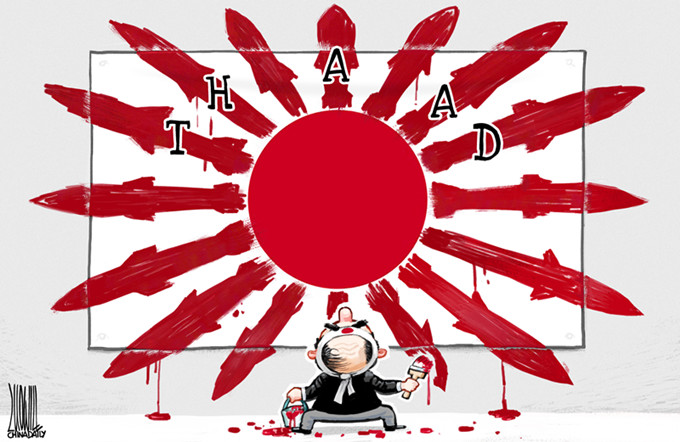
Russia visit should make Abe understand what is good for Japan and prompt him to give up his belligerent approach to issues
Time: Night. Date: April 30. Place: Japanese embassy in Moscow. The buzz of human interaction and the aroma of the finest Japanese cuisine fill the air. Amidst the buzz, some high-ranking Russian officials are enjoying the privilege of being served sushi by none less than Japanese Prime Minister Shinzo Abe. Abe serves the sushi with a smile and he has reason to do so: He has brought every dish being served at the dinner from Japan.
But Abe might not have smiled from within, for he knew that despite much being at stake during his visit to Russia, there was little for him to gain.
He was well aware that it was pivotal to build a relationship of mutual trust with Russian President Vladimir Putin to get a good bargain for Japan on at least four issues: a Russo-Japanese peace treaty, the status of the Northern Territory (Kuril Islands in Russian), energy, and economic cooperation. The first two represent historical questions and the last two economic aspects.
Russia and Japan have opposing priorities on the issues. For Tokyo, the historical questions take precedence. For Moscow, it's about business and business only. This has put Tokyo in a precarious position: It can raise a historical question only to the chagrin of Moscow. And at a joint press conference of Abe and Putin, when a Japanese correspondent did exactly that by asking about the territorial disputes, it didn't come as a surprise to see Putin brusquely brush aside the topic despite Abe's presence.
So what was at stake for Russia at the talks? Russia has its own struggles, which are of the economic kind. First, the Russian economy relies heavily on exports of resources, mostly oil and gas, and Moscow needs to expand its market to the East, especially after the recent gas pipeline disputes with Ukraine and Belarus and a faltering European demand.
Second, Russia is seeking foreign investments in Siberia and its Far East region, both of which have an exceptionally low population density. Russia believes that foreign investments could help exploit the resources in the region.
Third, it wants to free itself of the "resource curse" and transform from a resource-based to a high value-added economy. Here cooperation with high-tech Japan could be beneficial to Russia.
For Russia, therefore, the talks were all about economic issues and not, as Japan had hoped, about historical questions like a peace treaty and the Kuril Islands, which the two countries last discussed in 1956 and 2001. For Japan, however, the talks were frustrating: It doesn't know when they will resume and, even if they are, what Russia's terms would be.