A yen to try the balancing act
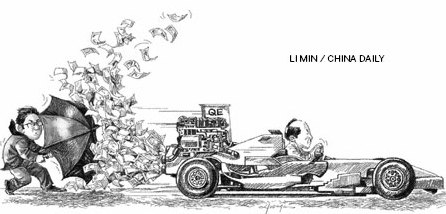
Bank of Japan's new governor, Haruhiko Kuroda, unleashed the world's most intense burst of monetary stimulus earlier this month, promising to inject about $1.4 trillion into the economy in less than two years. The radical gamble sent the yen reeling and bond yields hurtling down south.
For China, the most important issue is the negative impact of the move, that is, whether the yen's depreciation will trigger a currency war. But fears of a "currency war" are unwarranted. According to the currency management system in Japan, called "floating exchange rate system" like in many other countries, the yen always fluctuates with supply and demand. For instance, despite the interference with the dollar, euro and sterling after the outbreak of the global financial crisis, the basic trading rules have remained intact.
Besides, developed countries have an unwritten rule: the priority of making the arrangements lies with the United States. So Japan has to consider other developed countries' interests before devising its currency policy.
The unwritten rule came into full play during the global financial crisis when many mainstream economists in the US, and even the US government, "suddenly lost confidence" in the market because the real public debt was far beyond that revealed to the public. They feared the crisis had the potential to drive the US into bankruptcy.
It was then that the US financial leaders, led by the treasury secretary, put their special abilities into play. They decisively implemented various deleveraging measures to relieve the pressure and diverted the world's attention to the European Union debt crisis, taking the heat off the US.
The fact that the unwritten rule works perfectly well is evident when we take a closer look at the eurozone crisis. The situation in the eurozone, especially in countries like Greece, is no doubt bad, but overall the EU countries' national debt ratio is 88 percent compared with the US' 110 percent. This proves that as the "big boss" among the developed countries, the US has the privilege to judge others and make decisions for them.
To ensure a smooth economic recovery, what the US needed the most was a little depreciation of the dollar, which would boost its exports and increase the employment rate. And with the financial world's attention diverted to the eurozone crisis and the appreciating yen from 2008 to 2012, the US got the time and opportunity it needed to emerge out of the economic downturn.
So the depreciation of the yen, apart from the unwritten rule, can be attributed to three factors. First, a depreciating yen suits Japan's current economic situation. Since the global financial crisis didn't have that negative impact on Japan, the yen kept rising for about four years. Experts believe that a ratio of up to 90 yen to a dollar is good for Japan. Only if the ratio drops to 70 or 80 yen to a dollar can it a trigger currency crisis in Japan.