Ishihara's dangerous dream
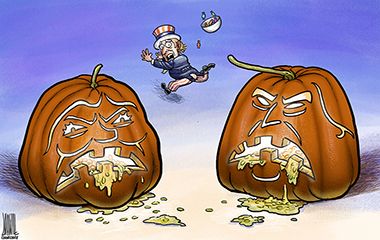
Politician wants to provoke a clash between China and the US so Japan can rise again as a political and military power
The seeds of the current crisis between China and Japan over the Diaoyu Islands originated with the national magistrate conference of Japan in April 2010 when the Japanese media tried hard to sensationalize the Chinese navy's normal activities.
Former Tokyo governor Shintaro Ishihara questioned then-Japanese prime minister Yukio Hatoyama on whether the Japan-US Security Treaty was applicable to China's Diaoyu Islands (known as the Senkakus in Japan). After reiterating the agreement reached by the United States and Japan during the Liberal Democratic Party's regime that the security treaty applied to the islands, Hatoyama said Japan still needed to talk with China about the sovereignty of the islands.
These words infuriated Ishihara and Japan's cyberspace was immediately filled with accusations that Hatoyama had "betrayed" his country. This was the first blow delivered by Ishihara in his scheme to overthrow the Hatoyama Cabinet, which was forced by the will of the Japanese people to dismantle because of the Futenma Air Base issue in July that year.
A "forbidden rule" was thus formulated that no Japanese politicians are allowed to acknowledge the dispute between Japan and China.
Then the collision between Japanese and Chinese vessels in the waters off Diaoyu Islands in 2010 during prime minister Naoto Kan's Cabinet plunged Sino-Japanese ties to a new low since the two countries resumed their diplomatic relations after World War II. Yet, the close economic and trade relations between China and Japan, the cooperation among China, Japan and the Republic of Korea in their efforts to establish free-trade agreements, and the progress in the negotiations between China and Japan on their currency swap gradually thawed the freezing diplomatic relations.
Ishihara, feeling uneasy with the improving Sino-Japan ties and seeking to enrage China, declared Tokyo would "purchase" the islands during his visit to the United States in late April 2012. He said if China opposed his purchase it would be declaring war with Japan. He chose to preach his nonsense in the US. But he had miscalculated, believing a war with China was already on the US' agenda because of Obama's return to the Asia-Pacific strategy. He then launched a fundraising campaign to "purchase" the islands and former Japanese prime minister Yoshihiko Noda took the opportunity to declare the "nationalization" of the Diaoyu Islands. Since then, the islands dispute between China and Japan has escalated into a crisis.